
Patient-centered care is a cornerstone of modern healthcare delivery, yet clinicians often misperceive how patients view disease burden, therapeutic goals and define treatment success.1-4 For example, while clinicians frequently focus on clinical outcomes, disease activity and evidence-based treatment algorithms, patients may place greater emphasis on symptoms, quality of life (QoL), daily functioning, emotional well-being and/or convenience. When these perspectives are not aligned, communication can suffer, shared decision-making may be compromised and treatment adherence and satisfaction can decline.
As educators for healthcare professionals, we are uniquely poised to address these discrepancies through continuing education (CE). By systematically collecting and comparing patient and clinician perspectives, this approach to CE can serve as a mechanism for fostering empathy, improving patient-provider communication and advancing patient-centered practice. Though outside the conventional realm of disseminating and translating clinical evidence, when designed carefully, this type of CE can help healthcare professionals recognize areas of misalignment, reflect on their own assumptions and develop communication strategies that better support individualized care.
Considerations for Data Collection
Identifying and addressing misalignment between patient and clinician perspectives begins with thoughtful data collection from both audiences. While educational planners are well-versed in collecting this type of information from clinicians who engage in their education, accessing similar information from patients can be more challenging. In instances where information does not exist in medical literature or public databases, CE planners can form partnerships with patient advocacy groups or data companies to reach the desired patient population.
Methods for Collecting Patient and Clinician Perspectives
A variety of quantitative and qualitative approaches can be used to capture stakeholder perspectives.
- Surveys: Provide an efficient method for collecting standardized data from large groups of patients and healthcare professionals. Survey-based approaches facilitate direct comparison of responses and allow educators to quantify the magnitude of perception gaps.
- Focus groups or interviews: Provide deeper insight into the reasons underlying observed differences. These qualitative methods can reveal contextual factors, emotional experiences and communication challenges that may not be captured through structured survey instruments.
- Published literature or registry data: Systematic reviews, patient-reported outcomes studies and qualitative research often identify recurring themes related to unmet needs, treatment priorities and communication barriers that can inform educational planning.
- Social media and digital platforms: Analysis of comments, discussion boards and online patient communities can provide insights into patient concerns, misconceptions and treatment experiences that may not emerge in traditional research settings.
Determining What Information to Collect
The design of the assessment instruments should be guided by the educational goals of the project, the topic area being explored and the specific types of insights needed to inform subsequent educational interventions. Is the goal to understand differences in perceived disease burden, treatment priorities, communication challenges, quality-of-life concerns or barriers to care? Whatever the goal, it is essential to formulate the questions in a way that makes sense for both patients and clinicians and to ensure that results can be easily compared. This means that ranking scales must be the same for both audiences and that the assessment was designed to evaluate the same idea.
Considerations for Question Design
Question format plays an important role in measuring perceptions and attitudes. When using a survey design, the following types of questions are useful:
- Likert rating scales: Assess subjective experiences, beliefs, priorities or levels of agreement with a particular statement. Unlike simple yes-or-no questions, Likert scales capture nuances in perception and facilitate comparison across stakeholder groups.5
- Ranking scales: Help determine the relative importance of symptoms, treatment goals or barriers to care.
- Multiple choice: Identify priorities, assess understanding or evaluate preferences among predefined options.
- Open-ended: Provide qualitative context and can uncover themes that may not appear through unstructured responses.
Example Analysis and Results
In our study, we utilized a mixed-methods design consisting of surveys and focus groups. Patients and clinicians were asked to respond to the same series of Likert-scale questions examining disease burden, treatment priorities, barriers to care and desired outcomes. By using identical questions across stakeholder groups, we were able to directly compare perceptions and identify areas of agreement and divergence.
Figure 1 shows that clinicians who treat patients with chronic spontaneous urticaria (CSU) underestimate the burden of disease compared to patients. Similarly, they underestimate the degree to which patients are willing to try new treatment options.
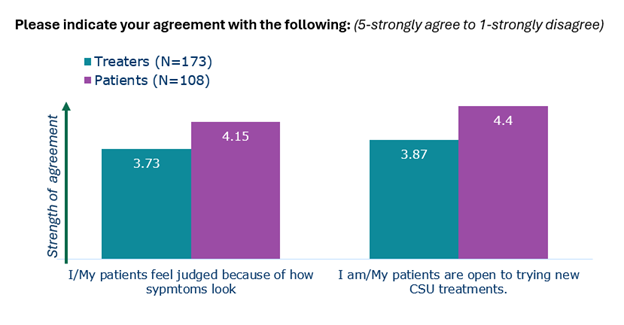
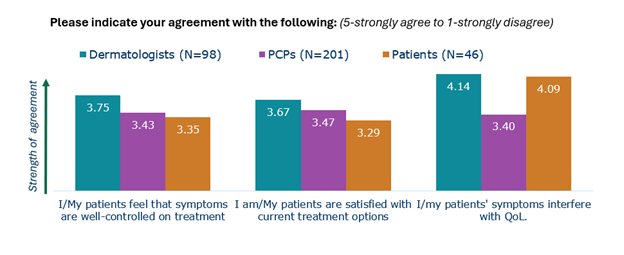
Figure 2 illustrates a somewhat different finding in that, compared to patients with atopic dermatitis (AD), dermatologists and PCPs overestimate the degree to which patients feel that their symptoms are well-controlled and are satisfied with their current treatment plan. Additionally, while specialists align with patient-perceived burden of disease on QoL, PCPs significantly underestimate the severity of this burden.
Integrating Findings into Clinician Education
Identification of misalignment is not the end goal. It is essential to integrate findings into clinical CE in a manner to promote reflection and behavior change. Visual displays of differences with faculty (clinician and/or patient) commentary can create powerful learning moments for clinicians. Integrating self-reflection by asking learners to answer the same questions that were posed in the study allows learners to compare their responses with both peer responses and patient-reported data. This process promotes recognition of potential misperception of patient experiences.
Educational interventions should not simply highlight discrepancies but also provide practical strategies for addressing them. These may include communication techniques, shared decision-making frameworks, approaches to eliciting patient goals and methods for incorporating patient-reported outcomes into routine practice. By positioning patient perspectives as a core component of evidence-based care, CE activities can help clinicians develop skills that support more meaningful patient engagement and individualized treatment planning.
Key Learnings and Call to Action
Misalignment between patient and clinician perspectives is common across healthcare settings and can influence communication, treatment decisions and overall care experiences. Continuing education provides a powerful and scalable mechanism for uncovering these gaps and translating findings into meaningful practice change. Educational planners should consider this type of study design to strengthen educational relevance and advance the broader goal of delivering truly patient-centered care.
References
- Robinson K, et al. Discordance Among Patients and Ophthalmologists Regarding the Burden of Intravitreal Injections. Clinical Ophthalmology. 2025; Aug 8:19:2637-2645.
- Premont M, et al. Patient and clinician perspectives on the diagnosis and management of polycythemia vera: results from concurrent surveys. Blood. 2025;146(Suppl 1):2653.
- Barker W, et al. The Evolution of Health Information Technology for Enhanced Patient-Centric Care in the United States: Data-Driven Descriptive Study. J Med Internet Res. 2024;26:e59791.
- Balogum O, et al. Patient-Centered Care Models: A Review of Their Influence on Healthcare Management Practices. Journal of Frontiers in Multidisciplinary Research. 2024 5(2):28-35.
- Sullivan GM, et al. Analyzing and Interpreting Data From Likert-Type Scales. Journal of Graduate Medical Education. 2013;5(4):541-542. doi:10.4300/JGME-5-4-18
Interested in this article? Join the discussion in the Alliance Community.
 Katie Robinson, PhD, CHCP, is the vice president of instructional design and analytics at Vindico. Uniquely positioned within Vindico, Robinson applies her background in clinical pharmacology and basic science research to analyze outcomes from prior CE activities to refine the instructional design and messaging of future programs. Actively involved within the CE community, Robinson earned her CHCP designation in 2019 and serves as the Editor-in-Chief and Chair of the Almanac.