
Most continuing education (CE) professionals rely on their learning management system (LMS) every day, yet many organizations only scratch the surface of what their system can accomplish. It’s often viewed as a platform for registration, evaluations and credit claiming, but it has the potential to become much more. The question is no longer whether your CE platform can manage educational activities; it is whether you are maximizing its ability to improve efficiency, support accreditation, capture and demonstrate educational outcomes, engage learners and showcase the value of your CE program. As expectations for CE programs continue to evolve, so should the way we think about our LMS. Rather than serving solely as an administrative tool, it can become a strategic asset that strengthens program operations, supports data-driven decision-making and demonstrates the impact of continuing education.
Are You Using Your LMS to Its Full Potential?
Many organizations implement a CE platform and continue using it exactly as they did on day one. As a result, valuable functionality often goes unexplored simply because users are unaware it exists. Over time, workflows become routine. Staff may continue performing tasks that were once necessary but have since been replaced by newer system capabilities. Taking time to step back and evaluate your current processes can reveal opportunities for improvement.
Ask yourself:
- Which features have we never explored?
- What manual processes are we still performing?
- Which reports are we creating outside the CE platform?
- What tasks are duplicated in spreadsheets?
- What are we still doing simply because "we've always done it that way," even though our system may now be able to do it for us?
One lesson I’ve learned is that you don't know what you don't know. Some of the best ideas come from seeing how colleagues use their CE platform to solve everyday challenges. User groups, conference sessions, vendor webinars and conversations with peers often reveal features and workflows that can be adapted to your own organization. Don't hesitate to ask your LMS support team questions; they often know capabilities that users may never discover on their own.
Working Smarter Through Automation
Perhaps the greatest opportunity for maximizing your LMS is through automation. CE departments are frequently asked to manage an increasing number of activities while meeting growing accreditation requirements and organizational expectations, often with limited staff and resources. Every hour spent sending repetitive emails, tracking attendance manually or updating spreadsheets is time that cannot be spent on educational planning, outcomes evaluation or innovation.
Before reading further, take a moment to assess how your organization uses its LMS.
If you answer "yes" to any of these questions, your LMS may have untapped potential or may not be fully meeting the needs of your CE program.
☐ We still rely on spreadsheets to manage CE processes.
☐ Staff manually send routine learner communications.
☐ Leadership requests reports that we create outside the system.
☐ We use only a few features because we're unsure what else is available.
☐ We haven't explored new LMS functionality in more than a year.
☐ Our learners frequently contact us for certificates or transcripts.
☐ We haven't attended an LMS user group or vendor training recently.
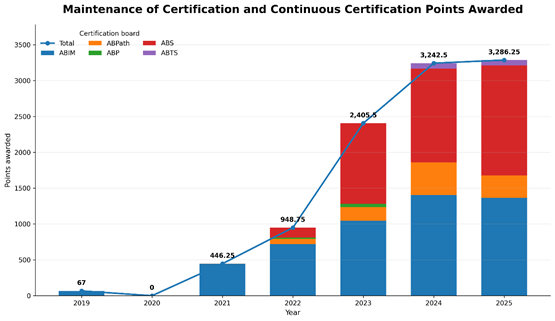
Our organization experienced this firsthand with Maintenance of Certification (MOC) reporting. Since implementing our CE platform in 2019, MOC reporting has been fully automated, with learner completion data transmitted directly to Program and Activity Reporting System (PARS). The impact of automating MOC reporting is illustrated in Figure1, which shows the growth in MOC points reported from 67 in 2019 to more than 3,286 in 2025. Managing that level of reporting manually would have required substantial staff time and increased the potential for reporting errors. Automation has allowed our program to grow while maintaining efficiency, accuracy and timely reporting for our learners.
Figure 1. Growth in Maintenance of Certification (MOC) Points Reported Following LMS Automation (2019-2025)
Automation extends well beyond MOC reporting. Most CE platforms can automate learner communications, reminder notifications, attendance verification, certificate generation, transcript management, faculty communications, PARS and Joint Accreditation reporting, ACPE Monitor, and many other repetitive administrative tasks. Every manual process should prompt one simple question: Can our system do this for us?
Turning Data Into Decisions
Beyond improving efficiency, a CE platform contains a wealth of information that is often underutilized. While attendance numbers remain important, they represent only a small part of the story. Your system can provide valuable insights into learner demographics, specialty participation, recurring attendance patterns, completion rates, evaluation trends, credit types, educational gaps and educational outcomes. More importantly, this data can be transformed into meaningful information that demonstrates the effectiveness and value of your CE program. Leadership increasingly expects CE programs to show how educational activities contribute to improved competence, performance, organizational priorities, and quality improvement, not simply attendance. Rather than collecting data solely for reporting purposes, CE professionals can use system analytics to identify trends, measure outcomes, support continuous quality improvement and inform strategic planning.
Designing a Better Learner Experience
The learner experience is another area where your CE platform can have a significant impact. That experience begins long before the educational activity itself. Online registration, mobile check-in, personalized learning dashboards, centralized transcripts, simplified certificate retrieval, automated reminders and easy access to enduring materials all contribute to a seamless experience.
Today's healthcare professionals are accustomed to digital experiences that are intuitive, personalized and available on demand. Whether banking online, shopping or booking travel, convenience has become the expectation. Learners now expect the same ease when registering for educational activities, claiming credit and accessing certificates. When administrative processes are simple and efficient, learners can focus their attention on learning. I often reassure learners during event check-in by saying, “If you can download digital shopping coupons, you can check in to our event.”
Supporting Accreditation and Compliance
When used effectively, the platform also strengthens accreditation and regulatory compliance. CE programs are responsible for managing disclosures, conflicts of interest, attendance verification, outcomes measurement, Maintenance of Certification reporting and extensive documentation. Leveraging LMS functionality to support these processes improves consistency, reduces administrative burden, and helps organizations remain prepared for accreditation reviews. Additionally, LMS vendors routinely update their platforms to reflect evolving accreditation requirements, allowing CE programs to adapt more efficiently to changes in standards and reporting requirements.
Scaling for Growth
As healthcare organizations continue to merge and expand, many CE departments are integrating teams, workflows, and technology platforms. These transitions present an opportunity to standardize educational operations, improve reporting, and create a more consistent learner experience across the enterprise. In our organization, we have managed 974 activities in our system over six months with a staff of four people. At that scale, standardized workflows, automated processes and centralized reporting are no longer conveniences; they are necessities. Fully leveraging our system allows us to support continued growth while providing a consistent experience.
The Power of the CE Community
Another valuable resource isn't found within the software itself. It's the community of CE professionals who use it every day. User groups, vendor forums and networking opportunities provide valuable insight into how other organizations have solved common challenges. Some of the best ideas come not from formal training but from conversations with peers who have discovered creative ways to use existing functionality. I experienced this firsthand during a recent system user group meeting.
Our team shared several forms we had developed within our system to streamline CE processes. What had become routine for our organization represented a new idea for others, sparking conversations about additional ways the system could be used. That experience reinforced an important lesson: features and workflows that seem routine in one organization may be completely unknown in another. Many features remain untapped not because they lack value, but because users haven’t had the opportunity to see how other organizations are using them successfully. The most valuable training comes from learning how another organization has approached the same challenge.
Supporting Continuous Improvement
Your CE platform can play an important role in continuous quality improvement. Evaluations, reflective questions, commitment-to-change statements, audience response systems, quizzes and follow-up assessments all provide meaningful feedback that can be used to refine future educational activities. Capturing learner feedback and outcomes over time allows CE professionals to continuously improve educational design while demonstrating the ongoing impact of their programs.
Putting Your LMS to Work
This technology is one of the largest investments most CE departments make, yet it is often underutilized. By exploring existing functionality, automating routine processes, leveraging meaningful data, improving the learner experience, supporting accreditation and embracing continuous improvement, CE professionals can transform their platform from an administrative system into a strategic asset that advances learners, planners and organizational goals.
Maximizing your LMS is not about purchasing new technology; it is about fully leveraging the technology you already have. Before your next educational activity, identify one manual process your team performs today and ask a simple question: "Can our system do this for us?" The answer may change not only your workflow, but the way you think about your LMS.
References
- Pilowsky, E. (2023, December 11). Best practices in utilizing LMSs for continuing professional development. eLearning Industry. https://elearningindustry.com/best-practices-in-utilizing-lmss-for-continuing-professional-developm…
- Smith, S. (2024, October 27). How LMSs support continuing professional education. eLearning Industry. https://elearningindustry.com/how-lmss-support-continuing-professional-education%20,%20October%2027
Disclosure: This article was developed with the assistance of generative AI tools. All outputs generated by the AI were critically reviewed, edited and validated by the author to ensure accuracy, originality, and alignment with current evidence and professional standards. The author assumes full responsibility of the final content.
Interested in this article? Join the discussion on the Alliance Community.
 Jennifer Kowalski, CHCP, is a senior CME specialist for Northwell Health Connecticut and the Hudson Valley. With 10 years of experience in accredited continuing education, she plans and manages educational activities in compliance with joint accreditation and ACCME standards and is committed to advancing healthcare continuing professional development through innovation and operational excellence.