
Three hours is a long time to ask clinicians to sit, listen and absorb complex information — especially when the program must cover a detailed set of required educational topics. At the 2026 AANP National Conference, we decided to interrupt that traditional rhythm. More than 300 attendees were asked to take out their phones, scan a QR code and enter a digital clinical escape room where they had to examine patient information, make decisions, uncover clues and solve a final puzzle.
The goal was not to add a game simply for entertainment. We wanted to reduce learner fatigue, create opportunities to apply new information in real time and identify misconceptions that might remain hidden during a lecture alone.
Since 2013, AANP has delivered opioid risk evaluation and mitigation strategy education at its national conference, traditionally through a three-hour seminar. Since the session must cover a substantial amount of content aligned with the FDA Blueprint, we began exploring ways to make the experience more active without sacrificing required content.
AANP partnered with Infograph-ed to develop three digital escape rooms that were integrated throughout the live session, “Pain Management and Opioids: A Patient-Centered Approach. “ Approximately 310 learners attended the program and accessed the rooms on their own phones or other devices. Each escape room followed the faculty’s delivery of a segment of didactic content, giving learners an immediate opportunity to apply what they had just learned to a clinical case. Leaderboards for each room, along with an overall leaderboard, added friendly competition and helped sustain engagement throughout the three-hour session.
Designing the Education Before the Game
Each clinical case was designed as a digital room, with key decisions presented through patient details, interactive resources, questions and clues. One of the most important lessons was that a self-directed case must stand on its own. Unlike a live presentation, there is no faculty member available in the moment to clarify missing or ambiguous information.
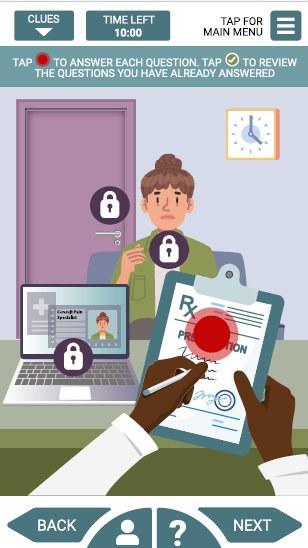
Therefore, we had to review every case from the learner’s perspective. Faculty played an essential role in this review.
- Did the patient history provide enough information to answer the question?
- Would learners know which details were important?
- Were the answer choices supported by information available within the room?
Our design partner, Infograph-ed, provided examples that helped us understand how traditional clinical content could be translated into rooms, hot spots, clues and final puzzles. Their team also helped us think through the full learner journey, including how participants would enter a room, locate information, answer questions, collect clues and determine the final escape code.
Preparing for the Live Experience
Testing involved much more than confirming that the answers were correct. We reviewed the rooms on the types of devices learners would use and tested the QR codes, instructions, navigation, timing, clue collection, final puzzle and room-completion process.
We also planned for onsite support. Two members of the Infograph-ed team attended the session and helped learners access and navigate the rooms. Their presence was particularly valuable in a large conference setting, where some participants needed assistance with device settings or understanding where to click. This allowed faculty and AANP staff to remain focused on the educational discussion.
Before learners entered the first escape room, faculty provided a brief orientation to the activity. They explained how to access the rooms, navigate the patient information and interactive elements, collect clues and use those clues to solve the final puzzle. Learners were also told how much time they would have to complete each room and how their completion times would contribute to the room-specific and overall leaderboard. Establishing these expectations in advance helped learners understand the process and added an element of friendly competition.
Following each room, faculty returned to the case and reinforced the major clinical takeaways. This debrief was important because the escape rooms were not intended to function as stand-alone games. They were part of a larger learning sequence that moved learners from didactic content to case-based application and then back to faculty-guided discussion.
To extend the activity’s reach beyond those who attended the national conference, AANP adapted the live program into an enduring online escape room experience. Faculty recorded the original slide presentation, and the resulting video was divided into shorter segments. Learners will view one audiovisual segment before each escape room case, followed by a final concluding segment after completing all three rooms. This structure preserves the sequence of didactic content followed by immediate case-based application that was used during the live session. The enduring version will include the same interactive cases, clinical decision points, clues and feedback, but learners will complete the activity independently and at their own pace without the live leaderboards.
What Did the Data Tell Us?
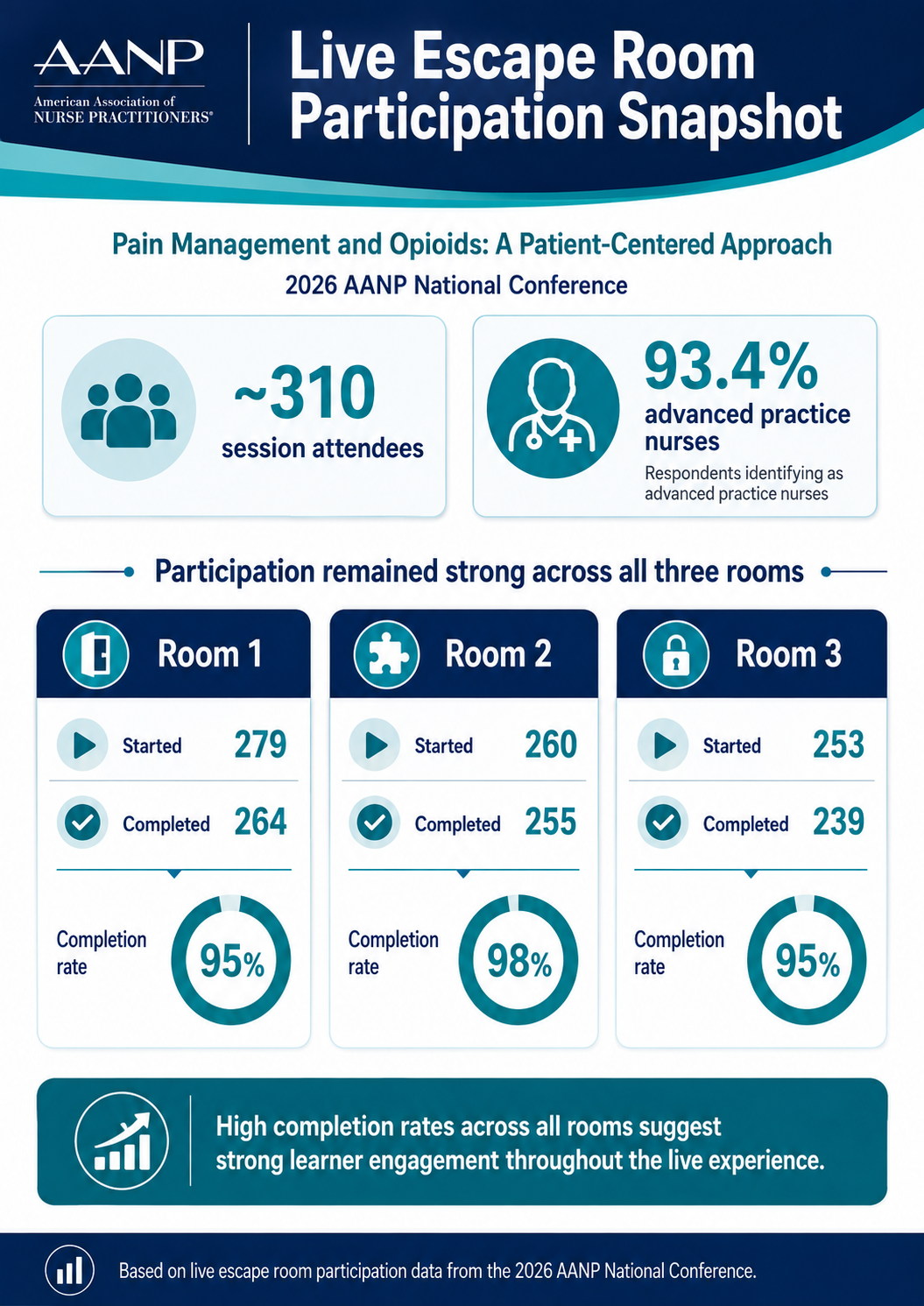
Participation remained high across all three rooms. Of approximately 310 session attendees, 279 began in Room 1, 260 began in Room 2 and 253 began in Room 3. Completion rates among those who started each room were 95%, 98% and 95%, respectively. The activity also reached its intended audience, of the 283 learners who reported their profession, 93.4% identified as advanced practice nurses.
First-attempt responses allowed us to see where learners entered the room with strong understanding and where important gaps remained. For example, only approximately 45% initially recognized a presentation of nociplastic pain, while 59% correctly identified a treatment that was mismatched to the type of pain. Performance was higher on questions addressing the relationship between adverse childhood experiences and opioid use disorder risk, initiation of buprenorphine in primary care and the use of shared decision-making to establish functional goals. First-attempt correct response rates for these decisions were approximately 71%, 83% and 77%, respectively.
These findings were valuable because they showed that the cases were sufficiently challenging to uncover misconceptions. The questions were not so easy that nearly every learner could advance without engaging with the supporting information.
The multiple-attempt structure also created an opportunity for immediate corrective learning. Learners who selected an incorrect response were encouraged to review the information in the room, reconsider their reasoning and try again. By the third attempt, correct responses increased to approximately 85% for recognizing nociplastic pain, 93% for matching treatment to pain type and 97% for selecting shared decision-making to establish functional goals. Performance also improved on questions addressing adverse childhood experiences and buprenorphine initiation. The data suggest that learners participated in the intended review – reconsider – respond process and used the educational content embedded in the rooms to correct misunderstandings. However, the live activity did not include a pretest or delayed follow-up assessment. The results should therefore be interpreted as evidence of engagement, immediate learning and successful completion — not as proof of long-term retention or sustained practice change.
Lessons Learned
Our experience reinforced that an effective educational escape room begins with the clinical decision, not the puzzle. Before developing clues or game mechanics, identify what learners should recognize, decide or do differently in practice. Every patient detail, hot spot and challenge should support that decision. Interactive elements that do not advance the learning objective may add clicks without adding value.
Feedback must do more than indicate whether an answer is correct. An incorrect response should direct learners back to relevant information and prompt them to reconsider their reasoning. This review – reconsider – respond process is where much of the immediate learning occurs.
Testing should mirror the actual learner experience. Review the activity on the phones, tablets and browsers learners are likely to use, and test QR codes, navigation, instructions, timing, clue collection and room completion. For a large live audience, plan for connectivity challenges and onsite assistance. Support staff allowed faculty to focus on education rather than troubleshooting devices.
The escape room should also be integrated into the broader activity rather than treated as a separate game. A brief faculty debrief can clarify misconceptions, reinforce key decisions and connect the experience to practice.
Finally, build the evaluation plan before launch. First-attempt responses can reveal important gaps, but baseline and follow-up assessments are needed to demonstrate change, retention or practice impact.
Getting Started
To begin developing an educational escape room, first define the learner gap, measurable learning objectives and clinical decisions the activity should address. Next, create a case-based narrative and design questions, clues and puzzles that require learners to apply the target knowledge rather than simply decode unrelated information. 1
Select an in-person or digital format based on the audience, setting, available technology and level of development support needed. Before launch, pilot the activity with representative users to identify unclear instructions, unintended logic gaps, accessibility or navigation barriers and technology issues.2 Finally, plan how facilitators will assist learners and debrief the experience so that key decisions, misconceptions and practice implications are reinforced. The development plan should also specify how learners will receive feedback and how participation and educational outcomes will be evaluated.
Key Takeaways
Digital escape rooms can support meaningful clinical learning, but the game mechanics alone are not enough. The educational value comes from realistic cases, purposeful clinical decisions, useful feedback, careful testing and a clear outcomes strategy.
CE teams considering this format should begin with the learner gap and the desired practice decision. Only then should they determine whether an escape room is the right vehicle for helping learners reach it. When the format is aligned with the educational purpose, it can transform a large live audience from passive listeners into active participants in the learning process. The digital format also allowed us to extend the educational investment beyond the live conference by adapting the rooms into an enduring activity for a broader national audience.
References
1. Geringer L, Shellgren M. When the puzzle is the training: designing escape rooms as experiential learning. OEB Insights. Published October 30, 2025. Accessed August 19, 2026. https://oeb.global/oeb-insights/when-the-puzzle-is-the-training-designing-escape-rooms-as-experiential-learning/
2. Angelilli S. Six design keys for escape rooms in nursing. AORN. Published October 5, 2023. Accessed August 19, 2026. https://www.aorn.org/article/six-design-keys-for-escape-rooms-in-nursing
Interested in this article? Join the discussion in the Alliance Community.
 Michele McKay, MSN, APRN, FNP-C, CHCP, is an NP Education Specialist at the American Association of Nurse Practitioners®. She has more than 13 years of experience developing accredited continuing education for nurse practitioner audiences, including case-based programs, interactive digital activities, podcasts, point-of-care tools and outcomes-focused initiatives. Her expertise includes educational design, grant-supported programming, faculty collaboration and evaluation strategy. She is a Certified Healthcare CPD Professional and a member of the Alliance for Continuing Education in the Health Professions.