
In Nov. 2023, the first Alliance survey on generative AI use in CME/CPD was deployed. It had been roughly a year since the initial public release of ChatGPT, and our questions were pretty simple: Have you even heard about this AI stuff? And have you tried using it in your work as a CME/CPD professional?
At that time, only about 51% of you had tried using AI in a professional capacity. When we checked in a year later, in Nov. 2024, that number had jumped to 85%, and a year after that, fully 95% of respondents were using AI in CME/CPD.
Today, it’s clear: we have moved beyond initial impressions. Increasingly, we’re wrestling with some well-known issues of AI: accuracy, governance, training and access, to name a few.
This article summarizes some key findings from the 2025 survey (N = 199 respondents) and introduces a new interactive dashboard that we can use to explore the underlying data together.
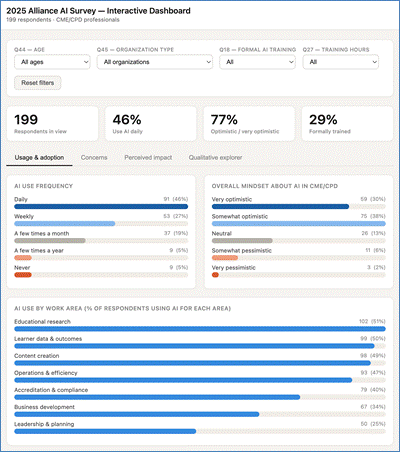
Adoption: AI Is a Daily Tool
The ACEhp AI Survey was open and distributed to the Alliance membership from Nov. to Dec. 2025.
Here’s the headline finding of the survey: in CME/CPD, routine use of AI has become the norm. Approximately 73% of respondents now use AI for their CME/CPD work at least weekly, including 46% who say they use it in that capacity daily, and another 27% weekly. For many of us, AI is now simply part of the workflow.
The 2025 survey asked two questions about each of seven CME/CPD work areas: do you work in this area, and, if you do, do you use AI for that work?
We thought that separating the two would give us a sharper picture, rather than treating them as a single metric.
In reality, the work area didn’t matter at all. Looking at needs assessment, outcomes analysis, operations, business development, accreditation anything else, about 80% to 90% of respondents are using generative AI in some capacity:
|
Work area
|
Use AI in that work
|
|
Educational research and needs assessment
|
89.5%
|
|
Learner data and outcomes analysis
|
89.2%
|
|
Operations and process efficiency
|
87.7%
|
|
Business development and strategy
|
87.0%
|
|
Content creation and writing
|
82.4%
|
|
Leadership and planning
|
82.0%
|
|
Accreditation and compliance
|
79.8%
|
The emerging picture is one of AI as a horizontal capability. We are adopting AI at consistently high rates across the full lifecycle of CME/CPD work, not concentrated in a single function.
When asked to describe their mindset about the role of AI tools in CME/CPD, 77% of respondents report being optimistic (43.1% somewhat, 33.9% very). Neutral responses account for 14.9%, and pessimistic responses for 8.0%.
The pessimists among you raised some important issues. These responses clustered roughly around three issues: hallucinations and accuracy (31%), environmental impact (8%) and the worry that reliance on AI will atrophy critical thinking skills (8%). But the rest of you were not naïve: in open-ended responses, we saw you repeatedly curbing your enthusiasm with explicit caveats. You talked about the need to supervise AI and fact-check its output. You told us that “human-in-the-loop” oversight should be the standard, not the exception. As one respondent put it: “I see great potential, but it definitely needs human guidance. It is a powerful tool, but just that, a tool.”
The ongoing problem of AI hallucinations and errors was a prominent theme throughout the survey. Despite billions spent on the development of advanced frontier AI models, factchecking and verifying AI-generated outputs is still a frustrating but critical necessity. As such, your “human-in-the-loop” instinct is the right one: consistent review remains the best practical safeguard against inaccurate outputs.
The worry that AI will erode critical thinking is well found, but will it turn out to be inverted? As AI literacy deepens, and we move beyond first-pass uses like summarization and quick research, the skill that gets exercised most may be the critical evaluation of what the model just produced.
As a community, we need to take these issues very seriously and keep them in dialogue. If you share these concerns, how can you make it known? Reach out to a colleague, submit an abstract or start a conversation.
Barriers: Training and Time, Not Access
A vast array of new AI models, applications and strategies are now yours to explore. But when are you going to find the time? In our survey, the two most common barriers to AI literacy were finding time to learn (43%) and lack of formal training (43%), both human-capital problems, rather than access problems. Even among daily users (N=91), only 40% have received any formal training.
Restrictions on AI usage ranked third (26.9%) as a barrier to AI literacy. One respondent reported that their “admin will decide how and for what we will be able to use it.” Several respondents, particularly independent contractors, flagged the inconsistency of client policies: one CME writer noted that some clients prohibit any AI use, while others actively encourage it.
Costs ranked fourth (18.3%) as an AI literacy barrier. The cost issue deserves a beat, because the price of accessing AI appears to be going up. Tech companies are rapidly building out their AI infrastructure, which is putting upward pressure on the price of phones, computers, software, electricity and even AI subscriptions themselves, often in the form of more strict usage limits. It will be interesting to see if cost becomes a bigger issue in our next Alliance AI survey, which we plan to deploy in Nov. 2026.
Governance: Policy Is Catching up, but Slowly
A growing number of our organizations now have formal AI policies in place: as of the Nov. 2025 poll, 45.7% of respondents reported a formal, organization-wide policy, with another 18.1% reporting informal policy or general guidance and 13.3% currently developing policy. About 14% reported no policy and 9% were unsure. Of the respondents with formal policies, over half (57%) were daily users, and 83% were optimistic of AI, contrasting with those with no policy (26% daily users, 64% optimistic). Organizational permission may correlate to reduction in uncertainty, not just an increase in use.
On day-to-day restrictions, 57.2% report being free to use AI for any work task, 41.2% can use it for some tasks but not others, and only 2.7% report that AI use is not allowed.
Roughly one in three respondents (33.2%) reports that their organization is using or developing custom in-house AI tools beyond off-the-shelf products like Copilot. We could interpret this as a signal that AI maturity is rising within many organizations in the CME/CPD ecosystem coupled with addressing concerns related to off-the-shelf AI platforms and security of proprietary data.
Implications for the Field
After reflecting on the 2025 Alliance AI survey responses, several implications stood out to us:
- Training is now a major constraint, with adoption outpacing opportunities to learn how to apply AI effectively in CME/CPD work. We should be treating AI literacy as a core CME/CPD competency, not an optional skill.
- Governance is catching up to practice, but unevenly. We feel that organizations without policy should not wait for perfect guidance before publishing at least a working framework.
- Human oversight should be the baseline, not an afterthought. Even AI-optimistic respondents tempered enthusiasm with explicit caveats, and hallucinations remained the most-cited concern across the survey. We should be building review of AI-generated content into standard CME/CPD workflows, especially as AI use becomes routine.
Explore the Data: the AI Survey Dashboard
To make these findings useful beyond this article, we have built an interactive dashboard summarizing the 2025 survey results, with demographic filtering and opportunities for you to evaluate open-ended responses. Check out the data, share it with your colleagues and ask us questions. Your feedback will be crucial as we plan the fourth annual Alliance AI survey in late 2026.
AI Disclosure
We used Claude Opus 4.7 (Anthropic) to develop preliminary drafts of this article, which we subsequently reviewed, edited, and rewrote. We also used Claude to develop the accompanying dashboard, which includes Alliance AI survey results based on deidentified data.
Interested in this article? Join the discussion on the Alliance Community.
 Andrew D. Bowser, ELS, CHCP, has worked in CME/CPD for more than 25 years as a medical writer, editor and strategist supporting accredited providers, medical education companies and professional societies across the educational lifecycle — from grants and needs assessments through content development and outcomes. He has been a member of the ACEHP AI Committee/Workgroup since its inception and has led the design, deployment and analysis of the Alliance’s annual AI use survey from 2022 through 2026. Bowser coauthored the 2024 Almanac article reporting baseline results of the inaugural AI in CME/CPD survey and contributed to the Alliance AI Position Statement (July 2024). He is a Board of Editors in the Life Sciences (ELS) editor and a Certified Healthcare CPD Professional (CHCP), and operates IconCME, a freelance practice based in Narberth, PA.
 Marie Judkins, BA, VP pf operations at CME Outfitters, LLC, has 21 years of experience in the CME industry. Over the past six years, she has championed health equity education, ushering more than 150 activities in this space and presenting equity outcomes at Alliance 2025. She is an author or contributor on Almanac articles on microlearning and AI integration, and a coauthor on 15+ posters presented at industry meetings. Education with her contribution have earned national recognition, including the 2025 Fierce DEI in Education Award, the 2025 NAMEC Excellence in Health Equity Education Award and the 2024 ACEhp Excellence in Education Award. She currently serves on the Alliance AI Committee and oversees grants, finance and outcomes teams at CME Outfitters, along with broader company operations and coordination with key external stakeholders.
 Jas Chahal, PhD, is the associate director for outcomes and insight at Medscape. She has over 20 years of experience collaborating with key stakeholders on multi-year, multi-site national research and CE projects. With a background in health services and evaluation research, her expertise includes mixed-methods research, survey design, real-world outcomes and leading QI initiatives to improve clinician performance and patient outcomes. Her work in continuing education has earned national recognition through awards for outstanding outcomes and outstanding educational collaborations. She currently serves the larger CE community as the chair for the Alliance Research Committee, a faculty member of the Alliance Leadership Institute and a member of the Alliance AI Committee.