
Please review the Alliance’s DEI statement for information from the ACEHP Board of Directors.
Diversity, equity, and inclusion (DEI) frameworks emerged during the Civil Rights movement of the mid-20th century as part of efforts to establish legal protections for Black Americans. Over the next several decades, the scope of DEI was expanded to include all historically marginalized populations, including those who identify as LGBTQ+. These frameworks were embraced by public health and medical professionals in the face of strong evidence demonstrating persistent health disparities across racial, sexual, and gender minority groups.1,2
As DEI frameworks have matured, resistance to them has also expanded. Today, continuing professional development (CPD) professionals operate in a volatile sociopolitical environment where DEI language and initiatives are under heightened scrutiny. Funding applications for DEI‑focused CPD require strategic language choices that balance accuracy, community integrity, and funder expectations. Efforts to sanitize DEI language often result in vague or euphemistic language that introduces error, misinterpretation, and can have or imply negative connotations (Table 1).3–5
Table 1 Risks of vague or euphemistic language
|
Application Section
|
Using Explicit DEI Terms (Evidence‑based, precise, structurally accurate)
|
Avoiding DEI Terms (Euphemistic, vague or funder‑risk‑driven)
|
|
Needs Assessment
|
“Racism, homophobia and transphobia contribute to disparities in diagnosis, treatment, and outcomes” 23,24
|
“Certain populations experience differences in care due to various social factors.” Obscures mechanisms and weakens causal clarity 25,26.
|
|
Population Description
|
“LGBTQ+ adults face discrimination in clinical encounters, leading to delayed care and avoidance.” 27
|
“Patients with unique needs may require additional support.” Pathologizing and unsupported by evidence. 27
|
|
Structural Determinants
|
“Structural racism and discriminatory policies shape access to care and health outcomes”.23
|
“Environmental and social issues may influence care.” Vague, nonactionable, and shown to perpetuate bias.24
|
|
Clinical Relevance
|
“Implicit bias contributes to guideline‑discordant care; addressing bias improves outcomes.”24
|
“Clinicians should be aware of cultural differences.” Weak predictor of behavior change.28
|
|
Educational Design
|
“Curriculum addresses structural inequities, discrimination and evidence‑based communication strategies”29
|
“Curriculum promotes inclusivity and awareness.” Performative and not tied to measurable practice change.28
|
|
Outcomes & Evaluation
|
“Learners will identify structural contributors to disparities and apply equity‑aligned interventions.”
|
“Learners will increase awareness of diverse populations.” Affective outcomes shown to have limited impact.28
|
|
Community Alignment
|
“Terminology reflects community‑endorsed language and avoids deficit framing.”1,30
|
“Neutral language will be used to avoid controversy.” Neutrality can erase identity and context.26
|
|
Funder‑Facing Framing
|
“Equity‑aligned CPD improves quality, safety and adherence to national guidelines.”2
|
“This program supports DEI values.” Rhetoric without evidence is increasingly scrutinized.31
|
|
Risk‑Sensitive Phrasing
|
“This activity addresses documented inequities using evidence‑based, clinically relevant strategies.” 29
|
“This activity avoids political terminology.” Avoidance language shown to reduce clarity and impact.24
|
|
Faculty & Expertise
|
“Faculty include clinicians and community partners with expertise in equity‑focused care.”17
|
“Faculty were selected to represent diverse backgrounds.” Risks tokenism.26
|
|
Justification for Funding
|
“Reducing inequities improves outcomes, reduces costs and meets national quality benchmarks.”2
|
“Funding this program demonstrates commitment to DEI.” Performative and not tied to clinical impact.17
|
One of the most harmful actions against science and public health taken by the current administration is the creation of a list of “banned” language that allegedly results in automatic rejection of any federal grant application, particularly those submitted to the National Science Foundation (NSF) and the National Institutes of Health (NIH). While no official government list exists, multiple sources have reported on the ban, and independent efforts have sought to compile a comprehensive list and make it available to the public.6–8 These sources report that the list contains anywhere from a few hundred to over one thousand banned words and phrases and includes terms such as “Black,” “women,” and “sexual preferences.” The inclusion of such a wide range of terms indicates that although the LGBTQ+ population is a major target in politics and media, it is simply one undesirable group on a list of the administration's agenda of social cleansing.9 The current administration is following a well-worn playbook of censorship and disinformation to pursue the cultural erasure of specific marginalized communities.10
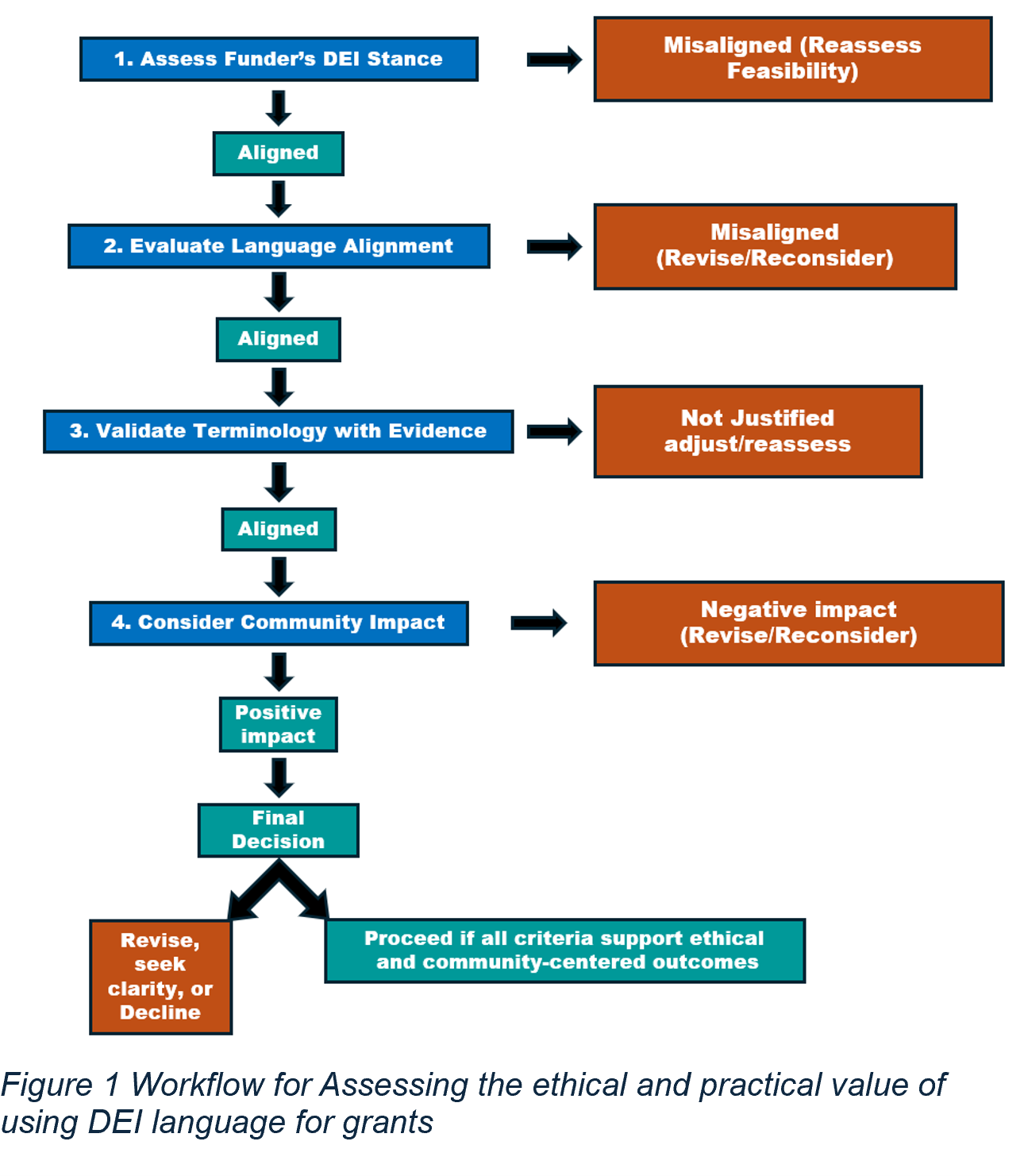
In response to the current climate, we present a framework for navigating the grant application process for CPD work that aims to address marginalized populations and health disparities (Figure 1). While our focus is on the LGBTQ+ community, the same framework can be used for any impacted population.
-
Assessing Funder Stance on DEI
The first step in this process is to ask, what is the funder’s stance in relation to DEI work, both historically and in the present moment? Start by searching their website for any language related to DEI and look for recent press or social media posts. Some funders are upfront about their enduring commitment to DEI, while others may maintain a commitment while obscuring their policies behind alternative language. Others may have completely abandoned their efforts. Knowing the funder’s stance can also help the CPD provider assess whether applying for funding is worth the investment.
One potentially effective CPD approach is to reframe language to remove DEI terms from grant applications. There is evidence to suggest that this tactic effectively improves the odds of receiving funding,11 allowing programs to proceed even in restrictive environments.12 Public administration and health policy research consistently shows that when political environments restrict the use of equity language, reframing goals in neutral or universalist terms allows programs to proceed without altering their substantive intent.13–15 While federal-level censorship of language has a harmful trickle-down effect on funders' tolerance for DEI language, shifts in DEI terminology do not necessarily reflect changes in research and education priorities. Andrew Jones notes in a study by The Conference Board that although 53% of corporations listed on the S&P 100 adjusted their DEI messaging in 2025, “this shift in public disclosure does not signal companies are abandoning DEI. Rather, they’re selectively reframing commitments, reducing public exposure and embedding oversight more quietly yet firmly into governance and human capital management”.16 The analysis indicates that companies, including those in the pharmaceutical and biomedical research industry, see value in DEI initiatives but may be risk-averse in their language use.
While the federal government attempts to erase representation of the LGBTQ+ community and other historically marginalized groups, nonprofit and independent, community-based organizations can serve as vital providers of funding for CPD work that addresses LGBTQ+ health disparities. Freelance CPD/CE medical writers should consider partnering with these organizations whenever possible to create educational content for both patients and providers that is not encumbered by language sanitation measures.
-
Matching Grant Language to Interventions
Before beginning a new needs assessment or gap analysis, the medical writer should communicate with the funder or independent medical educator (IME) to ensure that their alignment and priorities are clear and consistent. Then ask, does the language in the grant application match the goals of the intervention and the needs of the community or population it is targeting? Discuss any concerns about language use and potential for grant rejection. If they have specific concerns about language, discuss whether alternative language can be used to avoid automatic flagging while still preserving accuracy and intent.
In the face of federal limits on both funding and research priorities for LGBTQ+ and other populations falling under the DEI umbrella, a 2024 report by The Kaiser Family Foundation (KFF) highlights the need for accurate, affirming data collection practices that provide insights on the health needs of the community while preserving privacy and safety, as well as the need for respectful language use in clinical practice. This can only be accomplished when sub-groups are clearly identified by their preferred nomenclature.
-
Using Evidence-Based Terminology
As DEI language has grown increasingly common in grant proposals, funders of CPD increasingly expect this language to move beyond broad value statements toward population-specific, context-specific, and gap-specific descriptions, favoring proposals that articulate clear equity goals, defined populations and the structural barriers to be addressed.17 This aligns with broader critiques of performative DEI language in health professions education, where specificity and contextual grounding are essential for meaningful impact.18
Once aims and values have been articulated, ask, does the evidence justify the terminology being used to describe the target population? Where possible, CPD professionals should rely on epidemiologic data to justify terminology. Data itself can sometimes be sufficient to replace specific terms that are likely to be flagged. For example, rather than referring to a “health disparity,” report the specific data illustrating differences in health outcomes across populations. Operationalized terminology (e.g., “men who have sex with men,” “transgender women,” etc.) improves clarity and aligns with public health standards.1
In the context of LGBTQ+ health, all forms of CPD, as well as needs assessments and grants that are grounded in disparity data, should explicitly name and identify LGBTQ+ populations. Silence and obfuscation, on the other hand, constitute a form of marginalization that is especially harmful when embedded in CPD content, as it can have a direct impact on patient care. All CPD professionals should strive to avoid this negative outcome.
-
Community Impact
Finally, careful consideration must be given to the question: how will language choices impact the community targeted by the intervention? While a strategy that incorporates language sanitation may be effective in securing funds in the short term, the long-term costs must also be factored in. Avoiding explicit terminology in relation to marginalized populations can render the author complicit in the sociocultural erasure of these groups.19 The dynamic gains momentum with each step back from DEI representation. Furthermore, removing all language that refers to LGBTQ+ persons or other marginalized groups as such erodes trust in the populations subjected to these conditions, giving rise to the mantra, “if you can’t name us, you can’t serve us.”20 Thus, even though the DEI work may continue, removing DEI terms breaks trust with the target population, which diminishes the impact of CPD for the marginalized population.20
Regardless of how language may appear in grant applications, the language preferences of the community should always be preserved in educational materials. If different language is to be used in a grant application, discuss whether those terms will be incorporated into the resulting CPD product. The key question is, will sanitizing DEI language in funding applications contribute to existing health disparities?21 Each case is unique and differs in context and impact on the target population and must be weighed carefully. 21,22
The current historical moment calls for care and critical thinking, particularly from professionals working on projects that address health disparities and other DEI aims. When creating content for CPD, all efforts should be made to avoid self-censorship, and identity-specific language should be used wherever clinically appropriate. When working on needs assessments and grant applications, medical writers can use these questions as guidelines to assess the position of the funder and navigate situations where language may raise concerns. However, it must be acknowledged that there is no universal approach to this problem. Each case will be unique and will pose its own set of practical and ethical challenges, but this framework can serve as a roadmap for navigating the complexity of today’s sociopolitical climate.
References
- CDC. Unfair and Unjust Practices Harm LGBTQ+ People and Drive Health Disparities. Tobacco - Health Equity. March 25, 2025. Accessed April 7, 2026. https://www.cdc.gov/tobacco-health-equity/collection/lgbtq-unfair-and-unjust.html
- Smedley BD, Stith AY, Nelson AR, eds. Unequal Treatment: Confronting Racial and Ethnic Disparities in Health Care. National Academies Press (US); 2003. Accessed April 7, 2026. http://www.ncbi.nlm.nih.gov/books/NBK220358/
- Brier J. Infectious Ideas: U.S. Political Responses to the AIDS Crisis. University of North Carolina Press; 2009. Accessed April 7, 2026. https://www.jstor.org/stable/10.5149/9780807895474_brier
- Dawson L, Kates J. Overview of President Trump’s Executive Actions Impacting LGBTQ+ Health. KFF. April 21, 2026. Accessed April 24, 2026. https://www.kff.org/lgbtq/overview-of-president-trumps-executive-actions-impacting-lgbtq-health/
- Yam K. Trump’s DEI policy threatens already thin share of women and minorities in STEM, workers say. NBC News. January 30, 2025. Accessed March 23, 2026. https://www.nbcnews.com/news/asian-america/trump-dei-women-minorities-stem-rcna189879
- Banned Words List. 2026. Accessed April 21, 2026. https://thoughtcrime-checker.com/banned-words.html
- Connelly. Federal Government’s Growing Banned Words List Is Chilling Act of Censorship. PEN America. December 22, 2025. Accessed April 21, 2026. https://pen.org/banned-words-list/
- Yourish K, Daniel A, Datar S, White I, Gamio L. These Words Are Disappearing in the New Trump Administration. The New York Times. March 7, 2025. Accessed April 21, 2026. https://www.nytimes.com/interactive/2025/03/07/us/trump-federal-agencies-websites-words-dei.html
- Gowayed H. The ethnic cleansing of the United States will destroy it. The Guardian. December 13, 2025. Accessed May 1, 2026. https://www.theguardian.com/commentisfree/2025/dec/13/ethnic-cleansing-racism-us-trump-ilhan-omar-somalia
- Jaeger PT. The Immortality of Hatred and Revenge: The Interconnections of Censorship, Disinformation, and Cultural Erasure in the Book Bans Targeting Marginalized Populations. The Library Quarterly. 2025;95(1):4-41. doi:10.1086/733171
- Morgan M. Navigating DEIA Language Mandates: A Practical Guide for Public Health Policy Professionals. This Week In Public Health. March 24, 2025. Accessed April 29, 2026. https://thisweekinpublichealth.com/blog/2025/03/24/navigating-deia-language-mandates-a-practical-guide-for-public-health-policy-professionals/
- P. N. Navigating Federal Grants Amid—and After—EO 14151. GrantSmiths. February 7, 2025. Accessed April 29, 2026. https://www.grantsmiths.com/post/navigating-federal-grants-amid-and-after-eo-14151
- Reimagining Language Part 1: Public Health and Development Terms to Ditch in 2025. Vital Strategies. January 23, 2025. Accessed April 29, 2026. https://www.vitalstrategies.org/reimagining-language-part-1-public-health-and-development-terms-to-ditch-in-2025/
- Kim D, Barakat M. Fighting for Equitable Policies in the Movement and Moment. 2025. Accessed April 29, 2026. https://greenlining.org/2025/fighting-for-equitable-policies-in-the-movement-and-moment/
- Wang SXY, Song S, Nikolov MC, Tormala Z, Kaplan RM, Schulman K. Preferences for Shared Language for Health Equity Across the Political Spectrum. JAMA Netw Open. 2026;9(3):e260277. doi:10.1001/jamanetworkopen.2026.0277
- Parisi K. As government pressure against DEI grows, companies go quiet. HR Brew. August 14, 2025. Accessed April 27, 2026. https://www.hr-brew.com/stories/2025/08/14/as-government-pressure-against-dei-grows-companies-go-quiet
- King, Brown-Johnson C, Forneret A, et al. Promoting Diversity, Equity, Inclusion, and Justice in Grantmaking for Health Care Research: A Pragmatic Review and Framework. Health Equity. 2024;8(1):391-405. doi:10.1089/heq.2023.0263
- Shah D, Behravan N, Al-Jabouri N, Sibbald M. Incorporating equity, diversity and inclusion (EDI) into the education and assessment of professionalism for healthcare professionals and trainees: a scoping review. BMC Med Educ. 2024;24(1):991. doi:10.1186/s12909-024-05981-3
- Andoh E. The power of inclusive language for promoting racial equity. 2024. Accessed April 29, 2026. https://www.apa.org/monitor/2024/11/inclusive-language-guide-race-power
- Meyer IH. Prejudice, Social Stress, and Mental Health in Lesbian, Gay, and Bisexual Populations: Conceptual Issues and Research Evidence. Psychol Bull. 2003;129(5):674-697. doi:10.1037/0033-2909.129.5.674
- Charas S. DEI Under Threat: The Workforce Risks Of Project 2025’s Policies. Forbes. 2025. Accessed May 2, 2026. https://www.forbes.com/sites/solangecharas/2025/01/19/dei-under-threat-the-workforce-risks-of-project-2025s-policies/
- Kim YJ. The Impacts of Executive Branch Actions Attacking DEI Programs on Racial and Health Equity | Evidence for Action. 2025. Accessed May 2, 2026. https://evidenceforaction.org/blog-posts/impacts-executive-branch-actions-attacking-dei-programs-racial-and-health-equity-0?utm_source=copilot.com
- Bailey ZD, Feldman JM, Bassett MT. How structural racism works-racist policies as a root cause of U.S. racial health inequities. New England Journal of Medicine. 2021;384(8):768-773. doi:10.1056/NEJMms2025396
- Hardeman RR, Murphy KA, Karbeah J, Kozhimannil KB. Naming Institutionalized Racism in the Public Health Literature: A Systematic Literature Review. Public Health Rep. 2018;133(3):240-249. doi:10.1177/0033354918760574
- Metzl JM, Hansen H. Structural competency: theorizing a new medical engagement with stigma and inequality. Soc Sci Med. 2014;103:126-133. doi:10.1016/j.socscimed.2013.06.032
- Metzl JM, Roberts DE. Structural Competency Meets Structural Racism: Race, Politics, and the Structure of Medical Knowledge. AMA Journal of Ethics. 2014;16(9):674-690. doi:10.1001/virtualmentor.2014.16.9.spec1-1409
- Reisner SL, Poteat T, Keatley J, et al. Global health burden and needs of transgender populations: a review. Lancet. 2016;388(10042):412-436. doi:10.1016/S0140-6736(16)00684-X
- Forscher PS, Lai CK, Axt JR, et al. A meta-analysis of procedures to change implicit measures. J Pers Soc Psychol. 2019;117(3):522-559. doi:10.1037/pspa0000160
- Gichane MW, Griesemer I, Cubanski L, Egbuogu B, McInnes DK, Garvin LA. Increasing Diversity, Equity, and Inclusion in the Health and Health Services Research Workforce: A Systematic Scoping Review. J Gen Intern Med. 2025;40(7):1487-1497. doi:10.1007/s11606-024-09041-w
- Inclusive Language Guide. https://www.apa.org. Accessed April 28, 2026. https://www.apa.org/about/apa/equity-diversity-inclusion/language-guidelines
- Mehta N, Jena AB. Changes in diversity language in National Institutes of Health grant awards: observational study. BMJ. 2025;391:e087222. doi:10.1136/bmj-2025-087222
Interested in this article? Join the discussion in the Alliance Community.
 Heather Duncan, MPH, PhD, is a medical writer, health communications specialist and epidemiologist. She earned a PhD in English and has more than a decade of experience teaching research skills, professional writing and science and technology studies. She also holds an MPH and is currently pursuing a doctorate in epidemiology at the University at Albany. Her work focuses on the integration of artificial intelligence into public health, with particular interests in health equity and LGBTQ+ health. She serves on several committees within professional organizations, including the New York State Public Health Association and the New England Chapter of the American Medical Writers Association. She co-owns M&D Science Consulting and Communications LLC with Patrick Murphy, where she specializes in needs assessments, gap analyses, systematic literature reviews and continuing education for public health professionals.

S. Patrick Murphy, PhD, holds a PhD in biomedical science with a focus on molecular genetics and brings more than a decade of experience teaching MPH students scientific writing and public health biology. A dedicated patient advocate, he specializes in identifying and addressing healthcare gaps affecting marginalized and LGBTQAI+ populations through rigorous gap analyses, needs assessments and targeted educational design. As an experienced medical and scientific writer, Patrick develops manuscripts, graphical abstracts, literature reviews and plain language summaries that make complex research accessible to diverse audiences. He serves as program director for the New England Chapter of AMWA and contributes to equity in STEM and scholarship on AI in healthcare.