
Think about being a patient. When was the last time the same person greeted you, completed the initial assessment, performed diagnostics, provided results, discussed treatment options, prescribed devices or medicines, summarized next steps, scheduled follow ups, and completed the charting?
The World Health Organization (WHO) describes interprofessional education (IPE) as occurring when “two or more professions learn about, from and with each other to enable effective collaboration and improve health outcomes.” 2 At its core, IPE is about professionals learning together to work collaboratively together for better health outcomes.
Understanding how IPE has evolved over time helps CPD professionals apply lessons from the past to better support collaborative practice in the future. This article, part of the Alliance's 50th Anniversary series, looks back at the Almanac archive to learn from the history of CPD.
The Evolution of Interprofessional Education
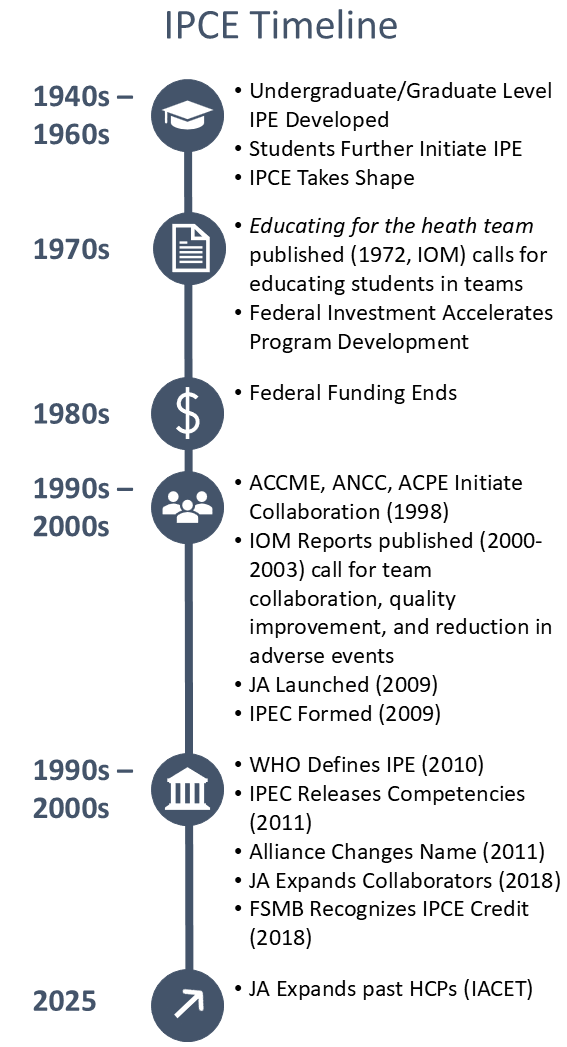
Although the concept of teamwork in healthcare emerged in the U.S. during the 1910s,³ interest and support in formalized interprofessional education (IPE) for the healthcare professions (HCPs) have fluctuated since the late 1940s.⁵⁻⁶ Early team‑based education efforts helped set the stage for the modern interprofessional movement — a point later emphasized in the Almanac “President’s Corner” (Mejicano, 2012), which reflects on how these early initiatives laid foundational principles for today’s IPE efforts.¹ By the mid‑1950s, the University of Washington developed and studied a model graduate‑level IPE program, using an interprofessional faculty team reflective of the students’ professions (medicine, nursing, psychiatry, social work, nutrition, etc.). In the 1960s, student‑initiated interdisciplinary summer programs provided academic and clinical IPE experiences, and by 1968 the first formal IPE initiative for practicing HCPs marked the beginning of interprofessional continuing education (IPCE).⁵ Federal investment in the 1970s⁵⁻⁷ accelerated the establishment of interdisciplinary training programs and expanded the “team” to include roles such as chaplains, although the withdrawal of government funding in the 1980s halted further development.⁵⁻⁶
Momentum resumed in 1998 when the ACCME, ACPE, and ANCC began collaborating on accreditation efforts, laying the foundation for Joint Accreditation (JA) in 2009.⁹ A retrospective 2020 Almanac article by O’Neill provides a firsthand account of the early JA process, describing the cultural, administrative and structural challenges that had to be addressed to break down silos and build a unified approach to continuing education across professions.¹¹ The Institute of Medicine (IOM) reports (2000–2003) further accelerated IPE/IPCE by highlighting patient safety risks, validating team‑based care and urging quality improvement.⁸⁻¹⁰ In 2009, JA marked an early regulatory advance⁹ by reducing longstanding barriers such as profession‑specific turf guarding, siloed accreditation requirements, administrative burden and cost.
Throughout the 2010s, IPCE growth was driven by healthcare reform and the creation of the Global Forum on Health Professions Education.⁶¹⁷ During this period, the WHO defined Interprofessional Education,² IPEC released the IPE competencies,¹² the Federation of State Medical Boards accepted IPCE credit,⁹ the Alliance expanded its name from “CME” to “Healthcare Professions,”¹³ and JA expanded to include more HCP credit systems. A 2021 Almanac article by Nyarko and the Alliance Research Committee highlights the state of IPCE today, including survey findings that reveal persistent challenges such as planner buy‑in, limited interprofessional representation on planning teams and operational barriers that continue to shape IPCE implementation.¹²
Today, IPE continues to evolve, increasingly incorporating non‑healthcare professionals as integral members of the care team.
Figure 1: IPCE Timeline
What We’ve Learned: Successes and Challenges
Reflecting on this evolution, there are both successes and challenges for CPD professionals working in IPE/IPCE. Each profession carries the burden of differentiation as well as collaboration.18 This tension should be expected and embraced. It’s okay to have the push and pull between autonomy and shared goals as it allows for adaptability in today’s rapidly evolving environment.
Both O’Neill (2020)¹¹ and Nyarko (2021)¹² emphasize that cultural barriers, siloed structures, lack of guidance, and inconsistent buy‑in remain significant challenges in implementing IPCE, underscoring the need for champions who can bridge professions and maintain trust across teams.
The art of IPCE is the management of many external forces to manifest a complete, satisfactory patient outcome as well as to minimize common collaborative obstacles. The goal is to build and sustain well-functioning teams that will reduce clinician burnout. Although IPE is shown to improve healthcare and patient experience, regulatory acceptance has a substantial impact on the initial and sustained support for IPE. IPCE Credit acceptance and promotion are crucial to encouraging providers, learners, and the healthcare system to solidify IPE’s position in CE.
Strategies to Advance Interprofessional Education
To continue moving IPE/IPCE forward, CPD professionals should consider the following.
- Advancing interprofessional education starts with sharing the same language: Does everyone really agree what interprofessional education really means? How do we confront the tension between a historic, pervasive hierarchical culture where the physician is the decisionmaker and the rest of the team defers? How do we decide who is on the team?
- Prioritizing how and who should work together: How to effectively define and execute roles and responsibilities, based on effective education, is just as or more important than any diagnostic or therapeutic competency, skill or strategy.
- Reframing targeted single profession education: When a role-specific educational intervention is developed, tying back to the concept a the team should still be expressed.
- Building a supportive community: Sharing knowledge, lessons learned, resources and experience will help create confidence in reframing targeted single-profession education and designing IPE-specific education.
- The value proposition is still evolving: We must continue to make the case for the value of IPE/IPCE — to learners, leadership, planners, faculty, funders and regulatory bodies.
Recommended Resources to Learn More
CPD professionals play a critical role in advancing IPE/IPCE by applying lessons learned from the past and implementing strategies outlined in this article.
The following resources provide additional opportunities to learn more about IPE/IPCE.
Recommended Journal Articles
van Diggele C, Roberts C, Burgess A, Mellis C. Interprofessional education: tips for design and implementation. BMC Med Educ. 2020 Dec 3;20(Suppl 2):455. doi: 10.1186/s12909-020-02286-z. PMID: 33272300; PMCID: PMC7712597.
Mohammed CA, Anand R, Saleena Ummer V. Interprofessional Education (IPE): A framework for introducing teamwork and collaboration in health professions curriculum. Med J Armed Forces India. 2021 Feb;77(Suppl 1):S16-S21. doi: 10.1016/j.mjafi.2021.01.012. Epub 2021 Feb 2. PMID: 33612927; PMCID: PMC7873741.
References
- Mejicano GC. President’s Corner. Almanac. 2012;34(1):1‑2.
- World Health Organization. Framework for Action on Interprofessional Education and Collaborative Practice. Geneva, Switzerland: World Health Organization; 2010.
- Cabot R. Social Service and the Art of Healing. Moffat, Yard and Company; 1915.
- Brandt B. Interprofessional education and collaborative practice: welcome to the “new” forty‑year‑old field. Advisor. 2015.
- Baldwin DC Jr. Some historical notes on the interdisciplinary and interprofessional education and practice in healthcare in the USA. 1996. J Interprof Care. 2007;21(suppl 1):23‑37.
- Pellegrino E. Educating for the Health Team. Washington, DC: National Academy of Sciences Report; 1972.
- Institute of Medicine (US). To Err is Human. Washington, DC: National Academies Press; 2000.
- Institute of Medicine (US). Crossing the Quality Chasm. Washington, DC: National Academies Press; 2001.
- Institute of Medicine (US). Health Professions Education: A Bridge to Quality. Washington, DC: National Academies Press; 2003.
- Interprofessional Education Collaborative Expert Panel. Core Competencies for Interprofessional Collaborative Practice. Washington, DC: IPEC; 2011.
- O’Neill S. A perspective on Joint Accreditation for Interprofessional Continuing Education (IPCE): the journey, critical areas of consideration and surprises along the way. Almanac. 2020; (Jan 22).
- Nyarko E, Alliance Research Committee. Interprofessional continuing education: where are we today? Almanac. 2021; (Nov 23).
- Oliver Wyman Health Innovation Center. The Volume‑to‑Value Revolution (Update). Oliver Wyman; 2014.
- Whyte S, Paradis E, Cartmill C, et al. Misalignments of purpose and power in an early Canadian interprofessional education initiative. Adv Health Sci Educ Theory Pract. 2017;22(5):1123‑1149.
- Edwards ST, Hooker ER, Brienza R, et al. Association of a multisite interprofessional education initiative with quality of primary care. JAMA Netw Open. 2019;2(11):e1915943.
- Hall P, Weaver L. Interdisciplinary education and teamwork: a long and winding road. Med Educ. 2001;35(9):867‑875.
- Institute of Medicine. Redesigning Continuing Education in the Health Professions. Washington, DC: National Academies Press; 2010.
- Schmitt MH, Gilbert JH, Brandt BF, Weinstein RS. The coming of age for interprofessional education and practice. Am J Med. 2013;126(4):284‑288.
Interested in this article? Join the discussion in the Alliance Community.

Samantha (Sam) Cribari-Starr is the director of professional development at the American Society of Addiction Medicine. With over 15 years of experience in corporate and nonprofit settings, she leads and manages workforce development programs that help healthcare professionals build their skills and improve patient care. She enjoys working with a diverse team of staff, subject matter experts, volunteers and external partners. She is also passionate about coaching and mentoring staff to support their growth.
 Caitlyn Keenan, MS, LSSGB, CHCP, is the associate director of accreditation education at the American Society of Addiction Medicine, where she oversees accreditation, certification and the Joint Providership Program. She ensures ASAM’s education complies with ACCME, Joint Accreditation and Maintenance of Certification requirements, and manages the Continuing Education Committee. A self-described CME/CE enthusiast, she is passionate about changing learner behavior, educating staff and joint providers, and satisfying Accreditation criteria. Her philosophy: accreditation should reward outcomes-driven education, not hinder it.
 Susan Yarbrough, CHCP, FACEHP, offers almost 25 years of accreditation and continuing medical education experience. Her roles have spanned the range, from a hospital-based academic research organization to leadership within industry-leading CE-accredited providers to her own consulting firm, CE Nerd 4 Hire.com. She currently serves as senior director, accreditation at Medical Learning Institute Inc. Susan also serves as director of provider relations and accreditation services for the Medical Association of Georgia. Yarbrough’s volunteer experience includes serving as a board member of the Alliance for Continuing Education in the Health Professions (ACEhp) as well as terms on the ACEhp’s CHCP Commission, chairing the CHCP Eligibility Committee, serving on the CHCP Commission, as well as service as a Joint Accreditation and ACCME surveyor. She was an early adopter of HCP CE/CPD professional certification (CHCP) and has been continuously certified since 2008. Yarbrough has been recognized by ACEhp as a Distinguished Member and Fellow. Her extracurricular activities include audiobooks, walking, hiking, and supporting her dog in the lifestyle to which they have become accustomed.