
In a digital education landscape offering programs of various sizes and formats, is achieving a bigger audience always better? Or are small groups where learners are seen, heard, and challenged the best option? This article unpacks the pedagogical and operational impact of massive open online courses (MOOCs) and small private online courses (SPOCs) to help instructional designers create effective, scalable programs that address the challenge of balancing reach with providing the most meaningful educational experience.
What is a MOOC?
A MOOC is a broadly accessible, large-scale online offering designed to disseminate knowledge to wide audiences. MOOCs commonly use asynchronous components (e.g., recorded modules, readings, quizzes) so busy professionals can engage on their own schedule. Many implementations also include light synchronous touchpoints — such as optional live Q&A, discussion sections or cohort check-ins — to boost connection and persistence.
Massive Open Online Courses (MOOCs) offer accessible, scalable and flexible educational opportunities for healthcare professionals to enhance their knowledge and skills.
What is a SPOC?
A SPOC is a limited-enrollment, instructor-guided online course built for interaction, feedback and application. SPOCs often include synchronous elements (live small-group sessions, breakout practice, coaching) and may combine these with asynchronous pre-work to focus live time on discussion and skills practice.
Small Private Online Courses (SPOCs) offer more personalized, limited-enrollment opportunities designed to provide targeted, interactive learning experiences for healthcare professionals.
Match Modality to Mission
Choosing between formats starts with intent. If your aim is broad awareness at scale, you’ll optimize for reach and flexibility. If you are focused on generating practice change, you’ll prioritize discussion, feedback and application.
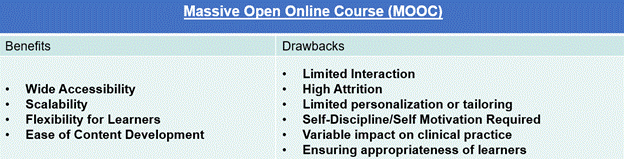
MOOCs generally excel at getting consistent information to large, diverse audiences with minimal scheduling friction. Think of them as your scalable backbone — efficient for foundational knowledge that set a common baseline. Consider MOOCs when:
- You need broad reach and consistent messaging at scale.
- Flexibility matters (variable schedules, rolling access).
- Goals focus on exposure and baseline comprehension.
- You want a reusable asset with low marginal cost per learner.
- Watchouts: Interaction can be light; persistence may dip.
- Potential boosts: Add brief live Q&A/office hours, short modules, progress nudges.
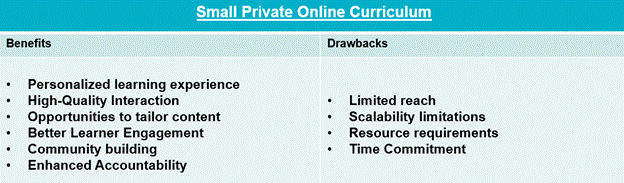
SPOCs tend to shine where nuance, judgment or skills practice are central. They create a space for learners to test ideas, get feedback and translate concepts to real cases — often where behavior change becomes visible. Consider SPOCs when:
- The aim is application, behavior change or complex reasoning.
- You need discussion, practice and feedback (role plays, cases).
- Stakeholders value learner connection and cross-discipline dialogue.
- You need richer assessment (observed skills, action plans, qualitative insights).
- Constraints to plan for: scheduling, facilitation capacity.
- Easy optimizations: asynchronous pre-work and collaborative projects + focused live sessions to maximize enrollment and engagement.
When to Blend (MOOC ➜ SPOC)
Some continuing education teams may consider combining the two: Use a MOOC for pre-learning (shared foundation, efficient reach), then a SPOC for application (discussion, practice, feedback) for motivated and highly qualified learners. Alternatively, the asynchronous foundational components of a SPOC can be subsequently adapted and utilized to create a MOOC to achieve broad reach for the content assets developed. This sequencing pairs broad reach with depth; the MOOC builds shared baseline knowledge, and the SPOC supports the development of higher-order reasoning and problem solving within facilitated cohorts. From an outcomes perspective, foundational content mastery can be assessed in the MOOC, while behavior and practice change indicators emerge in the SPOC.
Choosing With Purpose in Mind: A Quick Decision Lens
Start with the overall purpose of the curriculum, then pressure-test the design against your audience, topic and learning objectives. Consider the following questions as you consider your optimal approach:
- Goal: Are we aiming for awareness, reasoning or behavior change?
- Audience: How many learners, how diverse and how experienced?
- Complexity: Is the topic straightforward or practice-sensitive/nuanced?
- Interaction: What level of dialogue, feedback or coaching is needed?
- Assessment: What evidence matters — completion, comprehension or demonstrated application?
- Operations: What are the constraints (timeline, budget, faculty time), and can blending offset them?
Takeaways and Next Steps
In short, match modality to mission. MOOCs typically spread consistent knowledge efficiently; SPOCs create an environment for application, feedback and behavior change. Some teams get the best of both by strategically blending the two approaches.
Try this: Pilot a blended pathway — create a 20-minute MOOC primer, then invite a selection of participants to join a 45-minute SPOC experience including a synchronous discussion with one applied task. Review completion, engagement and data collected from both to decide how to best scale. After the pilot, capture lessons learned and create a playbook for future programs.