
The landscape of continuing professional development (CPD) in healthcare education shifts rapidly between live (in person or virtual) and enduring formats, leaving CPD educators and faculty to face a critical challenge of ensuring integrity of adult learning principles. The current emphasis often leans towards what format to use rather than how adults truly learn, risking inconsistent educational impact and hindering the vital translation of knowledge to action.
These 13 adult learning principles are offered as a pragmatic design spine for healthcare CPD. They translate adult learning theory into concrete decisions about sequencing, interaction and support, regardless of format. CPD teams can use them as a checklist for planning, as a common language for faculty development, and as a simple rubric to review activities against outcomes and accreditation expectations.
Designing for Relevance, Motivation and Autonomy
1. Relevance and Problem-Centered Design
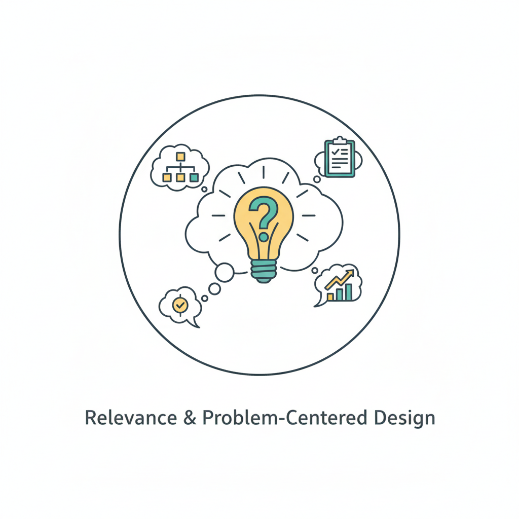 Adults engage when learning is framed around decisions they routinely face. A problem-centered approach uses authentic clinical and operational scenarios to focus attention on what changes patient care and team performance. By organizing instruction around decisions, not topics, faculty reduce noise, highlight consequences and make it easier for clinicians to see immediate value that is squarely aligned with adult learning and outcomes-planning frameworks. ¹˒²
Live example:
- Open with a local patient case and a clear decision point.
- Run a structured small-group case consult.
- Converge on two “will-do Monday” tactics supported by local data.
Enduring example:
- Start a micro-module with a branching vignette that forces a choice before revealing guidance.
- End with a one-page “If/Then” practice checklist.
2. Self-Direction and Choice
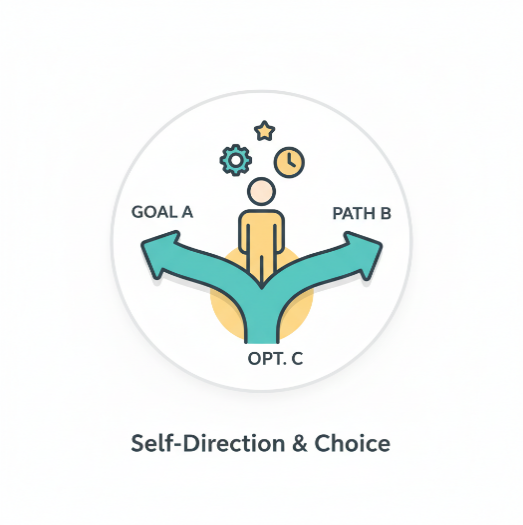 Autonomy is a hallmark of adult learning. Allowing clinicians to select goals, pathways, pace and format (e.g., video, print, live) respects professional judgment and increases time-on-task. Choice reduces wasted effort by targeting genuine gaps; environments that support autonomy, competence, and relatedness sustain motivation to persist through desirable difficulty.¹˒³
Live example:
- Offer parallel 20- to 30-minute mini-sessions mapped to a brief self-assessment at check-in.
- Staff guide participants to sessions that match stated gaps.
Enduring example:
- Present a modular pathway with optional “go deeper” nodes.
- Personalize recommendations from a short diagnostic quiz and allow bookmarking to build a self-directed plan.
3. Experience as an Asset (Peer Learning)
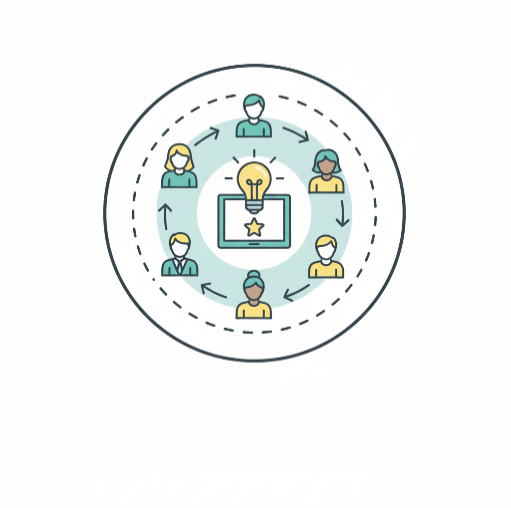 Adults bring mental models shaped by real practice. Make those models explicit, compare them with evidence and peer approaches, and refine them through structured discussion to improve accuracy and contextual fit. Peer learning builds credibility, surfaces blind spots, and accelerates adoption through observation, troubleshooting, and shared heuristics.⁴˒⁵,21
Live example:
- Use “1-2-All”: solo reflection on a case, pair comparison with assigned roles (case owner/skeptic), then room-wide capture of two high-yield tactics.
- Build in brief peer consults; reconvene at 30 days to share artifacts and results.
Enduring example:
- Run short case clubs with rotating facilitators.
- Maintain a curated protocol/template board (notes + change log) and require one substantive post plus one constructive reply.
- Share a “top three practice pearls” digest.
4. Motivation and Value: Purpose, Mastery, Autonomy, Practical Payoff
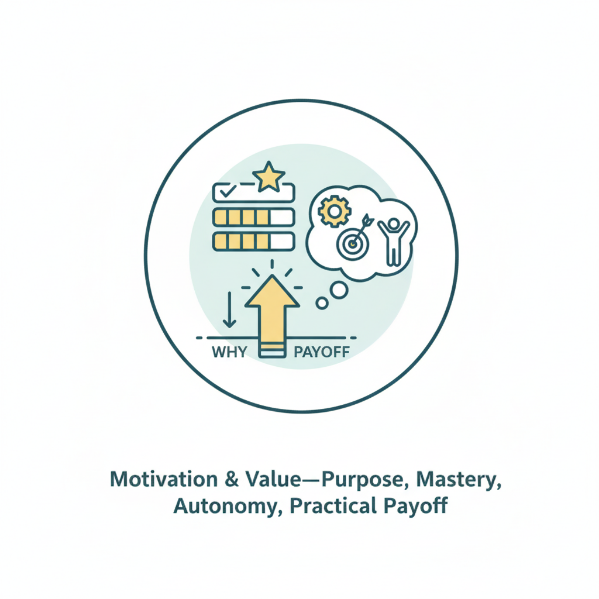 Adults engage when value is clear, progress feels attainable, autonomy is respected, and payoff is practical. Extrinsic incentives (credit, requirements) should reinforce, not replace intrinsic drivers tied to professional identity and goals (mastery, patient impact, efficiency). Make purpose explicit (outcomes, safety, time saved), set achievable challenges, acknowledge constraints, and use early wins plus peer modeling to sustain momentum. ¹˒⁵
Live example:
- Open with a patient story and local performance data.
- Codesign two feasible clinic-flow tactics during the session.
- Secure leader supports a small test of change.
Enduring example:
- A 60 second “why this matters here” video from a trusted clinician.
- Show expected benefit (time saved/errors averted).
- Prompt selection of a first micro-action.
Designing for Cognitive and Social Processing
5. Psychological Safety, Inclusion and Equity
 Learning depends on a climate where people can ask questions, name uncertainty, and challenge assumptions without penalty. Inclusive CPD uses cases, data, and strategies that fit diverse teams, settings, and historically marginalized patient groups, and it addresses structural barriers to participation (time, cost, access, accommodations). Psychological safety increases participation and improvement, and UDL helps remove barriers by design. ⁶˒⁷
Live example:
- Set norms at the outset.
- Use anonymous polling to surface dissent.
- Incorporate cases reflecting linguistic, cultural and resource diversity.
Enduring example:
- Offer anonymous formative quizzes and “muddiest point” submissions.
- Ensure captions/transcripts and inclusive imagery.
- Invite brief positionality statements from faculty when appropriate.
6. Accessibility and Universal Design for Learning (UDL)
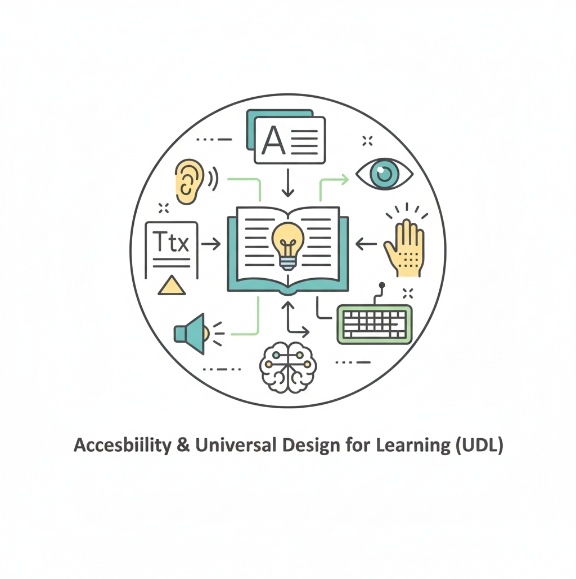 Design for the full range of abilities and contexts from the outset. Multiple means of engagement, representation and action/expression benefit everyone, not only those with identified needs. Captioning, transcripts, readable layouts and alternatives to color-only signaling are baseline quality measures. ⁷
Live example:
- Ensure microphones and sightlines.
- Provide printed/large-font materials and live captioning.
- Allow written question cards for those who prefer not to speak.
Enduring example:
- Provide captions, transcripts, keyboard navigation, alt text and audio-only and text summaries.
- Avoid color-only cues and flashing content.
7. Cognitive Load Management and Signaling
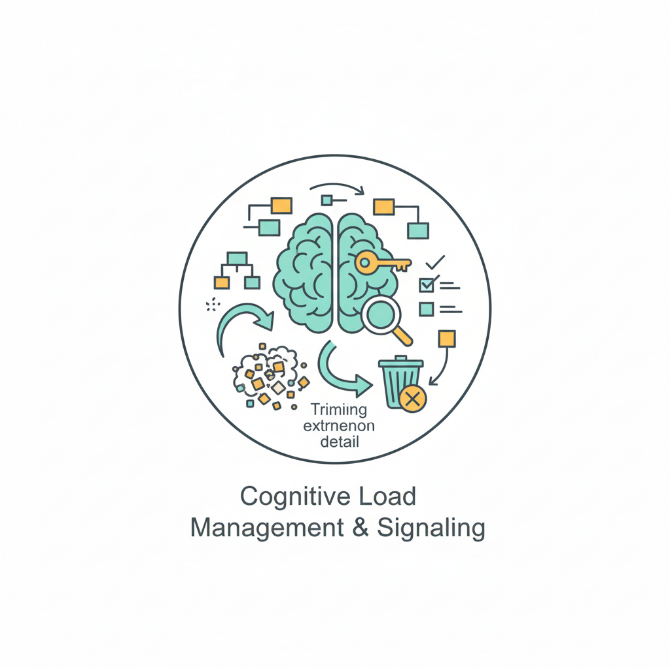 Complex content overwhelms quickly if cluttered, poorly sequenced or inconsistently signaled. Manage cognitive load by trimming extraneous detail, chunking intrinsic complexity and highlighting what to attend to and why. Consistent patterns and explicit cues reduce search costs and free working memory for reasoning and application. These approaches are well supported by cognitive load theory and multimedia learning research (e.g., coherence and signaling principles). ⁸˒⁹
Live example:
- One idea per slide, purposeful visuals and “Key Takeaway” labels.
- Segment into 10 to 15 minute bursts with quick prediction polls or think-pair-share.
Enduring example:
- Videos ≤ 7 minutes with on-screen signposts (Step 1/3).
- Progressive disclosure of details.
- Downloadable one-page summaries for offline reinforcement.
8. Spacing and Retrieval Practice
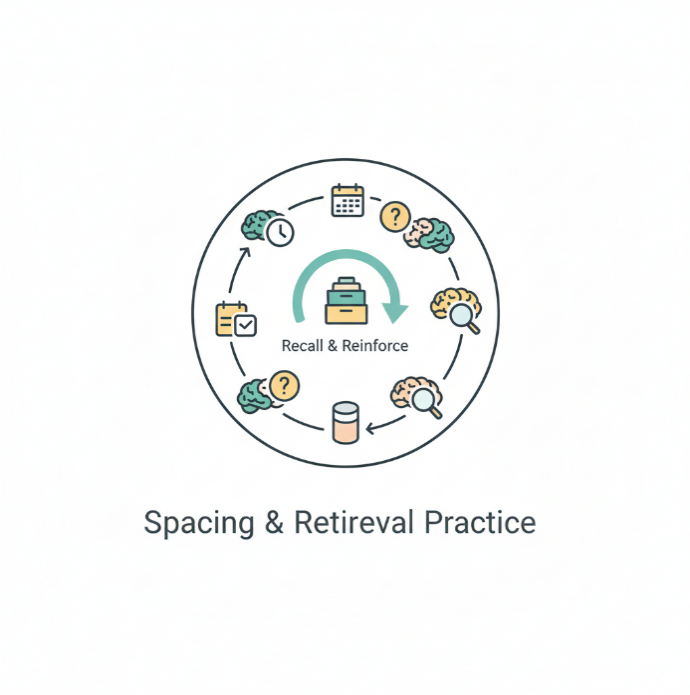 Spacing distributes exposure over time, while retrieval requires recalling knowledge without cues. Together they convert short-term gains into durable memory and fluent performance under pressure. The timing of gaps should expand across follow-ups, and effortful recall should anchor each touchpoint. ¹⁰⁻¹²
Live example:
- Run a three-week case series.
- Open each session with a three-question unaided recall quiz from prior sessions before introducing new complexity.
Enduring example:
- Push micro-quizzes at 48 hours, two weeks, and six weeks.
- Include confidence ratings to trigger targeted refreshers on low-confidence items.
9. Feedback That Changes Performance
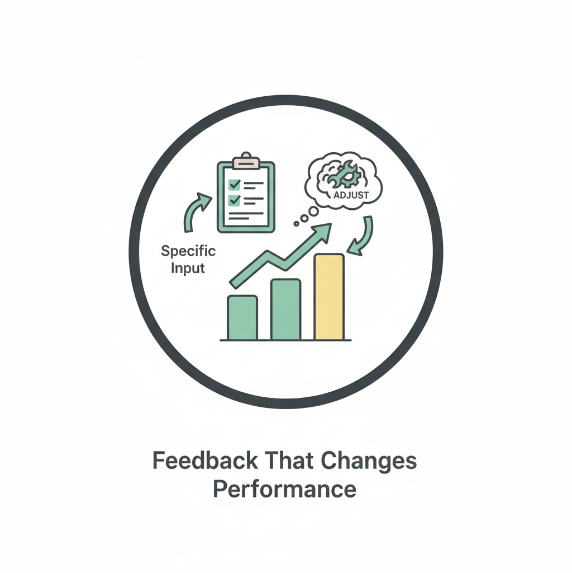 Feedback closes the loop from knowledge to skill when it is specific, behavior-based, timely and tied to a transparent standard. Effective feedback clarifies what best practices look like, what was observed and what to try next. The literature estimates larger effects of learning when feedback meets these conditions. ¹³
Live example:
- Skills stations using rubrics (e.g., motivational interviewing micro-skills) with brief video capture on a phone.
- Deliver one targeted behavior to adjust in the next repetition.
Enduring example:
- Scenario-based checks with targeted explanations keyed to rubric criteria.
- Optional asynchronous “critique my note/order” submissions with brief faculty comments.
10. Deliberate Practice, Simulation and Transfer
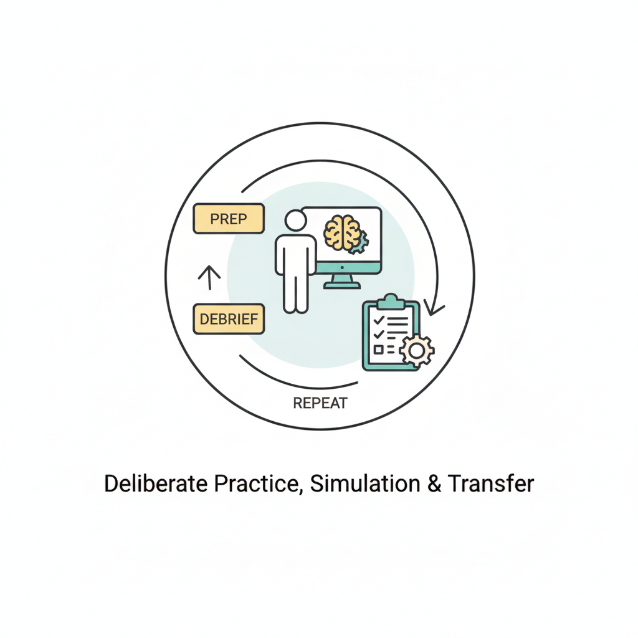 Complex performance improves through repeated, goal-directed practice that isolates subskills, adds complexity gradually and provides feedback each cycle. Simulation accelerates learning by safely approximating reality and revealing coordination gaps. Debriefing structures translate experience into explicit learning and transfer. ³˒¹⁴˒¹⁵
Live example:
- 10-12-minute session that handoff simulation followed by a checklist-guided debrief.
- Repeat and practice with a language barrier or staffing constraint to stress adaptability.
Enduring example:
- Interactive branching with timed elements affecting vitals and labs.
- Debrief screens mapping choices to outcomes.
- Export a concise “playbook” to support workplace use.
11. Reflection and Metacognition
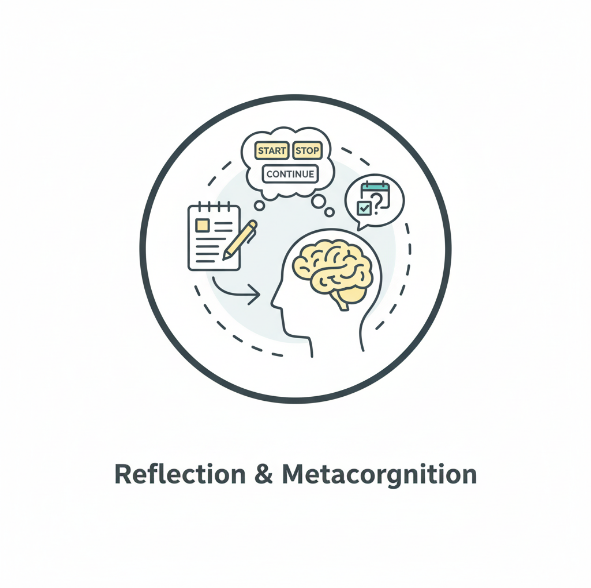 Reflection turns activities into learning by consolidating memory, surfacing gaps and planning applications. Metacognition monitors what is known and where uncertainty remains and guides self-directed improvement. Structured prompts (e.g., start/stop/continue, where/when/with whom) increase the likelihood of implementation. ¹⁶
Live example:
- Two-minute written reflection at close.
- Public sharing of one intended change.
- Collect commitment to change statements for 30 day follow up.
Enduring example:
- End of module reflection prompts with an “implementation note” template.
- Optional private journal to record obstacles and next steps.
Designing for Implementation and Outcomes
12. Assessment for Learning (Formative First)
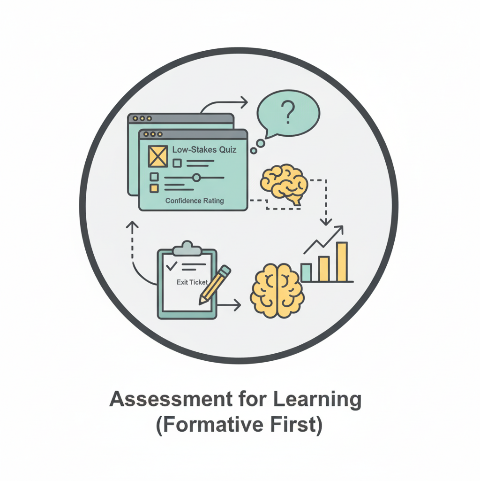 Assessment should guide teaching and self-correction, not only certify completion. Predictions, low-stakes probes and confidence-weighted responses surface misconceptions early and direct targeted support; confidence data also strengthens metacognitive calibration. Emphasize individual mastery and progress against clear criteria (not comparison to other learners) and use results to target follow-up and practice supports. ¹⁰˒¹⁷
Live example:
- Insert pause and predict moments and teach to the gaps revealed.
- End with a one minute “exit ticket” capturing lingering questions to inform follow-up.
Enduring example:
- Interleave low-stakes quizzes with immediate explanations and optional refreshers.
- Use confidence ratings to trigger personalized review items.
13. Implementation Pragmatics (Habits, Systems and Friction)
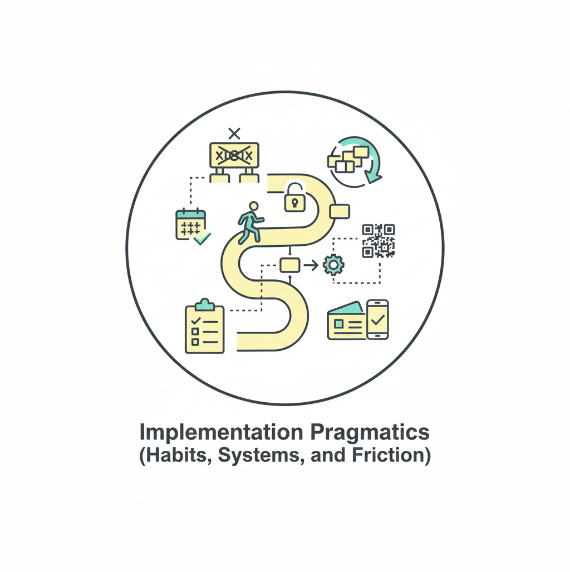 Even strong instruction fails without support that converts intention to habit. Align cues, scripts, checklists and team agreements and remove friction where possible. Make the first step small and observable, pair it with a trigger and define who will do what, when, and how results will be seen. Habit formation curves and behavior design models explain why small, cue-linked steps and timely prompts work. Use commitment-to-change (CTC) statements and outcomes frameworks to close the loop. ²˒ ¹⁸-²1
Live example:
- Cocreate a 30-day plan naming one behavior, one cue (when/where), one partner and one measure.
- Distribute pocket cards or QR links to tools.
Enduring example:
- End with a “practice starter kit” (checklist, patient script, two-minute how-to video).
- Optional calendar nudges to revisit progress at two weeks.
Designing With Format in Mind
Across principles, a reliable sequence improves fidelity: engage with a real decision, elicit predictions, teach only what shifts that decision, apply immediately, retrieve soon after and revisit with feedback and reflection. Use this sequence as a planning checklist for any live or enduring activity. In-person formats leverage social energy, rapid feedback, and hands-on rehearsal; enduring formats leverage branching, learner pacing, and spaced touchpoints.
Well-designed CPD activities are format-flexible when adult learning is applied disciplined. Anchor learning in real decisions; then use the principles above to support autonomy, manage cognitive load, and drive practice change. Applied consistently, whether in a conference room or on a screen, these principles produce durable changes in clinical decisions and patient outcomes. The charge is simple: teach only what elicits practice changes, and design every minute to make that change easier, safer and more likely to last.
References
- Knowles MS, Holton EF III, Swanson RA. The Adult Learner: The Definitive Classic in Adult Education and Human Resource Development. 8th ed. Routledge; 2014. doi:10.4324/9781315816951
- Moore DE Jr, Green JS, Gallis HA. Achieving desired results and improved outcomes: Integrating planning and assessment throughout learning activities. J Contin Educ Health Prof. 2009;29(1):1-15. doi:10.1002/chp.20001
- Eppich W, Cheng A. Promoting Excellence and Reflective Learning in Simulation (PEARLS): Development and rationale for a blended approach to health care simulation debriefing. Simul Healthcare. 2015;10(2):106-115. doi:10.1097/SIH.0000000000000072
- Kolb DA. Experiential Learning: Experience as the Source of Learning and Development. 2nd ed. FT Press; 2014.
- Bandura A. Social Learning Theory. Englewood Cliffs, NJ: Prentice-Hall; 1977.
- Edmondson AC. Psychological safety and learning behavior in work teams. Adm Sci Q. 1999;44(2):350-383. doi:10.2307/2666999
- CAST. UDL Guidelines 3.0. https://udlguidelines.cast.org/. Accessed November 12, 2025.
- Sweller J. Cognitive load theory. In: Ross BH, ed. Psychology of Learning and Motivation. Vol 55. Academic Press; 2011:37-76. doi:10.1016/B978-0-12-387691-1.00002-8
- Mayer RE. Multimedia Learning. 2nd ed. Cambridge University Press; 2009.
- Roediger HL III, Karpicke JD. Test-enhanced learning: Taking memory tests improves long-term retention. Psychol Sci. 2006;17(3):249-255. doi:10.1111/j.1467-9280.2006.01693.x
- Cepeda NJ, Pashler H, Vul E, Wixted JT, Rohrer D. Distributed practice in verbal recall tasks: A review and quantitative synthesis. Psychol Bull. 2006;132(3):354-380. doi:10.1037/0033-2909.132.3.354
- Bjork EL, Bjork RA. Making things hard on yourself, but in a good way: Creating desirable difficulties to enhance learning. In: Gernsbacher MA, Pew RW, Hough LM, Pomerantz JR, eds. Psychology and the Real World: Essays Illustrating Fundamental Contributions to Society. Worth Publishers; 2011:56-64.
- Hattie J, Timperley H. The power of feedback. Rev Educ Res. 2007;77(1):81-112. doi:10.3102/003465430298487
- Ericsson KA, Krampe RT, Tesch-Römer C. The role of deliberate practice in the acquisition of expert performance. Psychol Rev. 1993;100(3):363-406. doi:10.1037/0033-295X.100.3.363
- Issenberg SB, McGaghie WC, Petrusa ER, Gordon DL, Scalese RJ. Features and uses of high-fidelity medical simulations that lead to effective learning: A BEME systematic review. Med Teach. 2005;27(1):10-28. doi:10.1080/01421590500046924
- Schön DA. The Reflective Practitioner: How Professionals Think in Action. Basic Books; 1983.
- Gardner-Medwin AR. Confidence-based marking: Towards deeper learning and better exams. In: Bryan C, Clegg K, eds. Innovative Assessment in Higher Education. Routledge; 2006:141-149. doi:10.4324/9780203969670-25
- Lally P, van Jaarsveld CHM, Potts HWW, Wardle J. How are habits formed: Modelling habit formation in the real world. Eur J Soc Psychol. 2010;40(6):998-1009. doi:10.1002/ejsp.674
- Fogg BJ. A behavior model for persuasive design. In: Proceedings of the 4th International Conference on Persuasive Technology. Association for Computing Machinery; 2009:1-7. doi:10.1145/1541948.1541999
- Lockyer J, Fidler H, Ward R, et al. Commitment to change statements: A way of understanding how participants use information and skills taught in an educational session. J Contin Educ Health Prof. 2001;21(2):82-89.
- Wenger E. Communities of Practice: Learning, Meaning, and Identity. Cambridge, UK: Cambridge University Press; 1998. Cambridge University Press and Assessment

Heather Ranels, MA, MS, CHCP, FACEHP, is a leader in continuing professional education with expertise in accredited program development, learner engagement and education technology. With over 20 years of experience, she designs strategic curricula, drives accreditation excellence and collaborates with stakeholders to enhance professional learning. She is actively involved in the Alliance and currently serves as vice chair of the Almanac.
Join in on the conversation! Discuss this post on Alliance Communities.